
WEEK 10
Introduction
Cookery Topic:
Cakes
Cookery Method:
This week, we will be learning how to make and assemble the components of an opera cake. The cooking methods used would be baking the cake, tempering the chocolate, and whipping the Italian buttercream.
Dishes:
Opera Cake, Joconde Sponge Cake, Italian Buttercream, Ganache I, and Opera Glaze
Prior Knowledge:
I have not made an opera cake before. However, I and a couple of other students prepped a few of the components for Thursday's lab.
Learning Objectives:
This week, we will have Chef Marie McGarry from the Central Restaurant in Montgomery, Alabama as a guest speaker who will be teaching us how to assemble the opera cake. We will also "explain the three main goals of mixing cake batters. Mix high-fat or shortened cakes. Mix egg-foam cakes. Explain ingredient functions and the concepts behind formula balance. Scale, pan, and bake cakes correctly. Explain how to judge the quality of baked cakes and correct cake defects in them."
Gisslen, W. (2021). Professional Baking (8th ed.) [E-book]. Wiley.
Background
Scientific principles:
Mixing egg- foam cakes-"Most egg- foam cakes contain little or no shortening and depend on the air trapped in beaten eggs for most or all of their leavening. Sponge layers are often moistened with a flavored sugar syrup, to compensate the lack of moisture of the cake. There is not much fat in sponge cakes, as sponge bats with fat may split more easily. Flour four egg- foam cakes must be weak in order to avoid making the cake tougher than necessary. Most egg- foam cakes do not contain a lot a fat except for a Joconde Sponge Cake and a Chocolate Fudge Cake. " (Gisslen, 2021,pg. 396)
Origin:
There is debate on who invented the original opera cake. Some culinary historians have the opera cake dating back to the 1890s, while others say it was created in a Paris shop in the mid- 20th century. Many opera cake enthusiasts think that the best "place to buy opera cake is at Dalloyau, where it was named L' Opera in honor of the Paris Opera." ( Franklin, 2021)
Inspiration

Franklin, R. (2021, March 20). French Opera Cake: Not for the Fainthearted, But so Worth the Effort. The Spruce Eats. Retrieved March 16, 2022, from https://www.thespruceeats.com/opera-cake-recipe-1375077

Hill, C. (2021, October 9). Chocolate Opera Cake. The Redhead Baker. Retrieved March 16, 2022, from https://www.theredheadbaker.com/chocolate-opera-cake/

Field, A. (2019, October 28). Blackberry Opera. Patisserie Makes Perfect. Retrieved March 16, 2022, from https://www.patisseriemakesperfect.co.uk/blackberry-opera/
Sketch

Methods used:
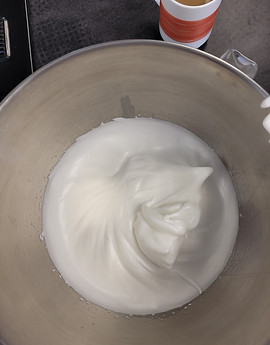
"The Joconde Method, like the separated egg sponge, contains a meringue added to the butter to lighten it. Joconde cakes, however, contain certain powdered nuts- usually almonds- as part of the dry ingredients. Joconde batter is usually deposited in sheet pans and baked in thin laters, for use in asssembling a variety of desserts. The procedures of the joconde method is: 1. Mix together the powdered nuts, confectioners' sugar, and flour in a bowl. 2. Add the eggs and whip until light. 3. Make a common meringue with egg whites and sugar, whipping until the meringue forms soft peaks. 4. Fold the meringue into the whipped mixture of eggs, sugar, nuts, and flour. 5. Fold in the melted butter. " (Gisslen, 2021, pg. 396)
Variations:
There is a hazelnut joconde sponge cake, where powdered hazelnuts are the substitute of the powdered almonds (Gisslen, 2021). Almond flour can be used in place of the powdered almonds. In opera cakes, the shape of the cakes can be squares or circles, and the ganache can also be fruit flavored. The garnish can range from chocolate curls, chocolate shards, edible gold foil, and/ or fresh fruit.
Franklin, R. (2021, March 20). French Opera Cake: Not for the Fainthearted, But so Worth the Effort. The Spruce Eats. Retrieved March 16, 2022, from https://www.thespruceeats.com/opera-cake-recipe-1375077
Gisslen, W. (2021). Professional Baking (8th ed.). Wiley.
Recipes

_edited.jpg)
_edited.jpg)
_edited.jpg)
_edited.jpg)
Plan of Work
.png)
Reflection:
Food Costing
_edited.jpg)
_edited.jpg)
_edited.jpg)

_edited.jpg)
Final Plating

Chef Marie's Opera Cake Demo


Mini Opera Cakes made in class
Results
The cooking techniques for the opera cake did work. The texture of the joconde cake was light light and airy. The taste was sweet, and there is a slight vanilla flavor. The appearance of the joconde was light golden brown, and the cake layer was thin. The texture of the coffee rum syrup is slightly thinner than maple syrup. The taste of the syrup is sweet and bitter, where the most prominent flavors of coffee and rum balance each other out. The appearance is dark brown, and the cakes were coated with the syrup during the assembly. The texture of the ganache was thick and smooth. The taste of the ganache was sweet, and the most dominant flavor is chocolate. The appearance is glossy, and the cooled appearance is more matte. The Italian Buttercream was smooth and light, with a frosting like- consistency. The taste of the buttercream was sweet, where the flavor of coffee was strong. The appearance was a light brown, as the coffee extract added color. The chocolate glaze was thin, the consistency was like milk. The taste was sweet, as chocolate is the most dominant flavor. The appearance of the glaze was shiny and glossy.
Evaluation
The jaconde method did work as mixing everything up before the meringue ensures a better consistency and less air is lost. Mixing the dry ingredients and the eggs for a long time, helped with reaching the ribbon stage. Making sure the melted butter was room temperature was crucial. If the butter is too hot, it will curdle the eggs. If the butter is too cold, it will not incorporate into the batter very well. It is best to mix the egg whites and sugar at the midpoint/ near the end of mixing the first ingredients. If we mixed it too early, the meringue would deflate. Folding the meringue was important, and we were able to fully incorporate the top portion of the cake mixture. But, there were areas of the bottom portion of the cake mixture did not fully incorporate the meringue. Next time, it would be best to do a few more passes on the bottom of the cake mixture, before pouring it in the pans. Tempering the chocolate for the ganache went well. I was melting the chocolate by water bath, but there was a chance to get condensation and water into the bowl of chocolate. I was recommended to switch to a double boiler method with a different bowl, so there is less chance of water going into the chocolate. Id did help prevent water going into the chocolate. We used an immersion blender to mix the chocolate and heavy cream. The blender did a great job in fully mixing the cream and chocolate. Assembling the cake into smaller molds were a little challenging, The hardest part was trying to layer the ganache and butter cream into the mold, since the small molds do not have much surface area. It was easier to put the cake into circle mold than the square, as the squares had corners, which made it harder to create an even layer. For next time, we could use slightly larger molds. The bottom of my mini square opera cakes were completely stuck to the plate, so the acetate may not have reached the bottom. Next time, I need to double check the acetate reaches the bottom layer of the cake.
Conclusions
I feel I did the best in making the joconde sponge cake. We were able to incorporate the meringue without it deflating on us. It baked to a nice color, and it did have a nice, springy texture. I learned from Chef Marie that egg whites in carton will not produce a higher lift and volume that egg whites from eggs will. It is due to fact that the eggs whites are pasteurized. I also learned about how important tempering is in making anything chocolate related, especially chocolate decorations. Chef Marie showed us how to make chocolate swirls, shards, and glaze. Chocolate takes a lot of patience as well as making cakes with multiple components. The skills that I need to practice coordinating various tasks.
Stages of Lab




.jpg)


