
WEEK 11
Introduction
Cookery Topic:
Cake II & Cake Assembling
Cookery Method:
This week, we will be tempering chocolate for the ganache. We will be baking a genoise sponge cake for cakes and petits fours. We will melting sugar for the meringues, Italian Buttercream, fruit based glaze, and dessert syrups. We will also be melting sugar for the poured fondant. The fondant will go on top of the petits fours. We will be baking a short dough crust for a fruit torte.
Dishes:
Italian Meringue, Short Dough I, Italian Buttercream, Crisp Baked Meringues, Apricot Glaze, Ganache, Genoise, Fondant, Almond Cake, Genoise a la Confiture Framboise, Fruit Torte, Petits Fours, and Chocolate Ganache Torte
Prior Knowledge:
In an earlier lab, I have learned about how to make a short dough. In last week's lab, I learned how to make ganache for the opera cake. I have made a common meringue and Swiss meringue, but I have not made an Italian meringue. I have not made Genoise sponge cakes, fondant, petits fours, and tortes before. In a previous lab, we made miniature fruit tarts using puff pastry, fruits, apricot glaze, and pastry cream.
Learning Objectives:
This week, we will learn how to "Prepare icings. Assemble and ice simple layer cakes, sheet cakes, and cupcakes. Perform basic cake-decorating techniques using a pastry bag, paper cone, and other basic decorating tools. Assemble cakes using a variety of specialized techniques, including the use of cake rings and the application of glazes and rolled coatings. Prepare a variety of small cakes." ( Gisslen, 2021, pg. 431) "Cook sugar syrups to various stages of hardness. Prepare whipped cream and meringues. Prepare crème anglaise and pastry cream variations. Prepare dessert sauces, ganache, and other chocolate creams." ( Gisslen, 2021, pg. 261) Sugar, chocolate, frosting, and syrup are multiple components that add more textures and flavors. The overall cake or dessert will be more interesting with multiple layers working together.
Inspiration

Lau, A., Theodorou, S., Jaime, E., & Tiefenbach, J. (2019, November 19). [Chocolate Ganache Torte]. Bon Appetit. https://www.bonappetit.com/recipe/chocolate-ganache-tart

Gryphon, A., & Gore, M. (2020, June 17). [Fruit Tart]. Delish.Com. https://www.delish.com/cooking/recipe-ideas/a32896550/fruit-tart-recipe/

Masterclass staff. (2021, August 5). Petit Fours Recipe: How to Make Petit Fours Glacés. MasterClass. Retrieved March 23, 2022, from https://www.masterclass.com/articles/petit-fours-recipe

Gisslen, W. (2021b). Professional Baking [E-book]. In Professional Baking (8th ed., pp. 476–477). Wiley.
Gisslen, W. (2021). Professional Baking (8th ed.) [E-book]. Wiley.
Background
Scientific principles:
The Genoise method is when the eggs, sugar, and salt are stirred in a steel bowl over boiling water, until the egg mixture's temperature reaches 110 F. This step is important as the foam will achieve a higher volume at a warmer temperature. Using a mixer's wire whisk, it is best to whisk at high speed to incorporate a lot of air and volume. Then, a switch to the medium speed is necessary to create a more union structure. The liquid ( water, milk, flavoring agent) will need to added either through whisking or stirring. Next, fold in the sifted flour and in smaller portions, being careful to not deflate the foam. It is best to do it by hand, and other dry ingredients like cornstarch and baking needs to be sifted with the flour. Immediately pan and bake the batter, and delays cause lose of volume. " ( Gisslen, 2021, pg. 397)
Origin:
"The French name petit four is from the baking method originally used to make sweet treats. During the 1800s in France, an oven was a stone cabinet with a fire with a fire underneath it. There was little to no temperature control, where French bakers only had two oven settings: blazing hot and cooling down. The blazing hot setting was reached when the coals under the oven were at maximum capacity. This mode of cooking was referred to in French as " grand four"- the English translation is "big oven". This mode was mostly used for cooking meats. During the cooling process, when the oven retained heat, was referred as "petit four," or small oven. The trapped oven was hot enough to cook tiny pastries." (Larson, 2022). Petit fours became a pastry staple in France, and it's presence is seen in bakeries across the world.
Methods used:
The filling of petit fours can have a multitude of fillings like Italian Buttercream. The procedures to make Italian Buttercream is: "1) Italian meringue must be made, and it should be completely cool. The sugar to the meringue must reach 237 F before adding it to the egg whites. 2) Gradually add small amounts of soft butter and whip. In the same way, whip in the shortening, if using, or additional butter. 3) When all the fat has been incorporated, whip in the lemon juice and vanilla. 4)Continue to whip until the texture is smooth and, it will become light and smooth with continued whipping."( Gisslen, 2021, pg. 436)
Variations:
The variations of fillings in petit fours can be Italian, Swiss, French, or American Buttercream. The flavorings can be chocolate, fruit, nut, or any other type of flavoring. "Petit fours glaces are iced petit fours, where the items are tiny eclairs, tartlets, filled meringues, and cakes. Most iced or creamed pastry items can be considered a petit four as long as it is small enough to eat in two bites. In North America, the most common petit four is cake cutout iced with fondant. " ( Gisslen, 2021, pg. 487)
Gisslen, W. (2021a). Assembling and Decorating Cakes. In Professional Baking (8th ed., pp. 431–436). Wiley.
Gisslen, W. (2021b). Basic Syrups, Creams, and Sauces. In Professional Baking (8th ed., p. 261). Wiley.
Gisslen, W. (2021c). Cake Mixing and Baking. In Professional Baking (8th ed., p. 397). Wiley.
Larson, S. (2022, January 18). How To Make Petit Fours: A Brief History & Recipes. Escoffier Online. Retrieved March 23, 2022, from https://www.escoffieronline.com/tiny-pastries-the-petit-four-story/
Recipes

_edited.jpg)
_edited.jpg)
_edited.jpg)
_edited.jpg)
Plan of Work
.png)
Reflection:
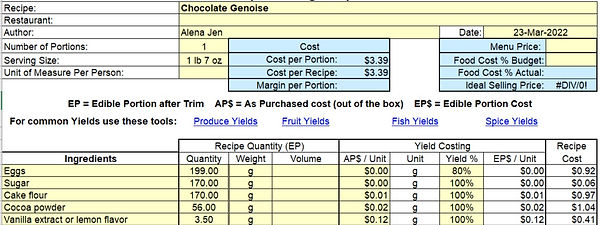
Food Costing
_edited.jpg)
_edited.jpg)
_edited.jpg)
_edited.jpg)
_edited.jpg)
Final Plating


Results
The cooking technique for the genoise cake did work. The texture of Genoise was slightly dense, springy, tight, and a bit dry. The taste is sweet as there is not salt added to the sponge cake. The flavor of the chocolate and vanilla is prominent, and it balances nicely with the raspberry buttercream. The appearance of the Genoise was a light golden brown, while the chocolate was a darker brown. The cooking technique of the buttercream did work. However, i think we used American buttercream. The texture was smooth with a few pieces of the raspberries in the buttercream. The taste was sweet as buttercream is mostly sugar and, the raspberries add more sweetness. The flavor the raspberries were dominant, and it complimented both Genoise cakes. The pink of the buttercream gives a nice contrast to the chocolate and vanilla Genoise. It reminds me of Neapolitan ice cream with the brown, white, and pink layers. The chocolate ganache torte's texture had a springy cake texture, and a smooth and thick ganache filling. The taste was sweet as chocolate is in every component of the torte. The cake, filling, and glaze was chocolate. The crisp baked meringues were the garnish for the chocolate tortes. The meringues added a crunch texture to the torte. The flavor of chocolate is strong and, the meringues complimented it. The appearance of the chocolate ganche tarte had meringue swirls and baked meringues as the decoration. The white of the meringues stood out against all of the chocolate elements.
Evaluation
The Genoise method worked because stirring the chocolate over the boiling water helped create more volume. When we just did the creaming method for the regular Genoise cake, it had less height and volume than the chocolate one. Using the sponge method ensures that more air and volume is added into the batter. One solution is to use the sponge method over the creaming method for all the genoise batters. Since the genoise tends to be more dry, it is important to cover the cakes in syrup before adding the buttercream. It would make the assembly more efficient, and the syrup adds more moisture to the cake. The buttercream also helped with combating the dryness of the cake. The cake's texture was slightly drier than expected, so it may have been in the oven too long. Next time, it may be best to take it out a minute or two earlier. The chocolate glaze for the chocolate torte did not have enough to set, so there was a lot of excess glaze going onto the plate. We transferred the cake to a a resting rack and to a new plate. Next time, it would be better to use the resting rack when using the mirror glaze. Placing the torte in the fridge to set would also help keep all the layers more intact. We had short dough cut out for the fruit torte, but the dough got too warm. The short dough and to be placed back into the fridge to chill. Next time, it would be better to get started on the short dough earlier in the lab, so there is more time to roll out, chill, shape, and bake.
Conclusions
Based on the this week's learning objectives, I feel I did the best at making the Genoise cake. I utilized the Genoise method, which helped create more volume. I learned how to assemble a chocolate ganache torte using concepts and techniques from previous weeks. The additional knowledge I learned was that the method is crucial for the best result in making cakes. One method will not work for every cake. Uniformity in pastries is noticeable, especially when making larger volumes. Uniformity is a significant part of the overall presentation of food, and it goes beyond pastries. I still need to practice on becoming more efficient in the assembly of cakes and tortes. It won't happen overnight, and it is a skill that needs to be consistently used in order to get better.
Stages of Lab


