
WEEK 12
Introduction
Cookery Topic:
Cookies & Frozen Desserts
Cookery Method:
This week, we will be learning various mixing methods and baking different types of cookies. The mixing methods are: one stage, creaming, and sanding. We will learn how to prepare a wide range of cookies like dropped cookies to bar cookies.
Dishes:
Guava Ice Cream, Icebox Cookies (Checkerboard), Butter Tea Cookies, Short Dough I, and Citrus Bar
Prior Knowledge:
I have not made homemade ice cream and lemon bar. The bagged type of cookie, butter tea cookies is a new recipe that I learned this week. I have made an icebox type of cookie, but it was only once. I made a swirl cookie at home before.
Learning Objectives:
Inspiration

Martha Stewart Living Special Issues 2001. (2010, December 26). Checkerboard Cookies Recipe. Martha Stewart. https://www.marthastewart.com/314590/checkerboard-cookies
This week, we will: "Describe the causes of crispness, softness, chewiness, and spread in cookies. Prepare cookie doughs by the three basic mixing methods. Prepare eight basic types of cookies: dropped, bagged, rolled, molded, icebox, bar, sheet, and stencil. Bake and cool cookies properly. Explain how to judge the quality of cookies and correct defects in them" ( Gisslen, 2021, pg. 491). We will learn the fundamentals of preparing cookies, which will vary depending on the desired type. This week, we will also learn how to prepare ice cream from scratch. We will: "Judge the quality of ice creams and sorbets and common ice cream and sorbet desserts. Prepare ice creams and sorbets. Prepare still-frozen desserts, including bombes, frozen mousses, and frozen soufflés." ( Gisslen, 2021, pg. 567)
Gisslen, W. (2021a). Cookies [E-book]. In Professional Baking (8th ed., p. 491). Wiley.
Gisslen, W. (2021b). Frozen Desserts [E-book]. In Professional Baking (8th ed., p. 567). Wiley.
Background
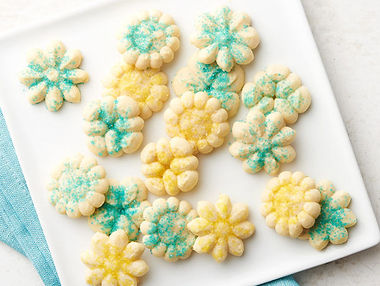
Classic Spritz Cookies - Gold Medal Flour. (2004, January 1). Gold Medal Flour. Retrieved March 30, 2022, from https://www.goldmedalflour.com/recipes/classic-spritz-cookies/ccd9d7f3-6075-4593-be61-7b0aeb02bc88/

Scientific principles:
The cookie characteristics of crispness, softness, and chewiness are based on the ratios of the sugar, liquid and fat content. "The factors that contribute to crispness is low liquid, where most crisp cookies are from stiff dough. High sugar and fat content. A higher portion of these ingredients is crucial to making a more workable dough with the low moisture content. The baking time must be long enough to evaporate the moisture. A small size or thin shape. This leads to a faster drying time. Proper storage. Crisp cookies can become soft when they absorb moisture. Softness is the opposite of crispness, so it will have opposite causes: High liquid, low sugar, and fat. Honey, molasses or corn syrup are added. The sugars are
Miller, S., & Bickel, A. (2022, March 10). Classic Lemon Bars. Simply Recipes. Retrieved March 30, 2022, from https://www.simplyrecipes.com/recipes/classic_lemon_bars/

Allen. (2021, December 22). Pink Guava Ice Cream Recipe. Recipes.Net. Retrieved March 30, 2022, from https://recipes.net/dessert/ice-cream/pink-guava-ice-cream-recipe/
hygroscopic, which means they absorb moisture from the air or their surrounding environment. Underbaking the cookies is one cause, and they tend to be a large size or thick shape, which helps retain more moisture. Proper storage is important as soft cookies can dry out and become stale. Moisture is necessary for chewiness , but there are other important components. All chewy cookies are soft, but not all soft cookies are chewy. The following factors found in chewy cookies are: High sugar and liquid content, but low fat content. High proportion of eggs. Strong flour or gluten during the mixing. " ( Gisslen, 2021, pg. 492) Spread is also another desired characteristic in cookies, but others may want to hold their shape." High sugar content increases spread. Coarse granulated sugar increased spread, while fine sugar or confectioners' sugar reduces speed. High baking soda or baking ammonia content encourages spread. The creaming of the fat and sugar to leavening by incorporating air. Low oven temperature increases spread. High temperature decreases spread because the cookie sets up before it has a chance to spread too much. A slack batter- that is, one with a high liquid content- spreads more than a stiff dough. Strong flour or activation of gluten decreases spread. Cookies spread more when baked on heavily greased pans." (Gisslen, 2021, pg. 493)
Origin:
"The word cookie came from the Dutch word koekje, meaning "little cake"- is used only in North America. In Britain, these little cakes are known as biscuits, although English biscuits are usually smaller than North American cookies and almost always crisp rather than soft and chewy. Immigrants from many countries brought their favorite recipes for little sweets with them to North America, and as a result we enjoy cookies that originated in Scandinavia, Britain, Germany, France, Eastern Europe, and elsewhere." ( Gisslen , 2021, pg. 492) Before, North American cookies were rooted in their European origins, where the cookies are smaller and crisp. At the end of the 20th century, the public began preferring soft and chewy cookies. However, the middles were slightly raw in the center, as the bakers were under baking the cookies. Eventually, they modified the cookie formula, so the centers are fully cooked. Due to North America's preference "for larger portions led to cookies of increasing size. " (Gisslen, 2021, pg. 492)
Methods used:
creme anglaise is the main component of the making ice cream. Creme anglaise is a vanilla custard sauce that "consists of milk, sugar, and egg yolks stirred over very low heat until slightly thickened, then flavored with vanilla. " ( Gisslen, 2021, pg. 270) The eggs can curdle when making custard sauce. It is best to ensure that all equipment is clean and sanitized. Before cooking, it is best to set up an ice bath to cool down the custard. "When mixing the egg yolks and sugar, whip the mixture as soon as the sugar is added. Heat the milk to scalding before adding the egg yolks. Then, slowly beat the hot milk into the beaten eggs and sugar. Next, set the bowl containing the egg mixture in a pan of simmering water and stir constantly to prevent curdling. To test for doneness, two methods are possible. Check the temperature with the thermometer. When it reaches 180 F (82 C), the sauce is cooked. When the mixture lightly coats the back of a spoon,...the sauce is cooked. Immediately pour the sauce through the strainer into the bowl set in ice water to cool the sauce quickly. Stir occasionally to cool it evenly. If the sauce accidentally curdles, it is sometimes possible to save it. Immediately stir in 1 to 2 ounces ( 30 to 60 mL) cold milk, transfer the sauce to a blender, and blend at high speed. " ( Gisslen, 2021, pg. 270)
Variations:
The ice cream flavor can be chocolate, vanilla, fruit, and can contain nuts. A cookie can contain chocolate, fruit, nut, or any other desired flavor. The texture of the cookie will vary depending on the desired result of the chef. The preparation of the cookies can vary from rolled, molded, icebox, bagged, dropped, sheet, bar, and stencil.
Gisslen, W. (2021a). Basic Syrups, Creams, and Sauces. In Professional Baking (8th ed., p. 270). Wiley.
Gisslen, W. (2021b). Cookies. In Professional Baking (8th ed., pp. 492–493). Wiley.
Recipes


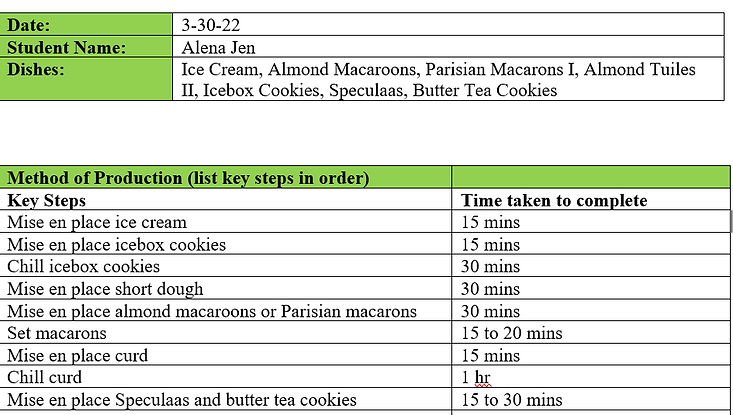
Plan of Work
.png)
Reflection:
Food Costing


Results
Yes, the cooking technique for the guava ice cream did work. The texture of the ice cream was soft and instantly melted in your mouth. The taste of ice cream was sweet, and the most prominent flavor was the guava. The appearance was a vibrant, peach color, and it looked smooth like a sherbet. Yes, the cooking technique for the icebox did work. The texture of the icebox cookie had a slight crunch on the outside, but the center and overall texture was soft. The taste of the icebox cookie was sweet, and the chocolate and vanilla flavors complimented each other. The appearance is a checkerboard and striped
Final Plating


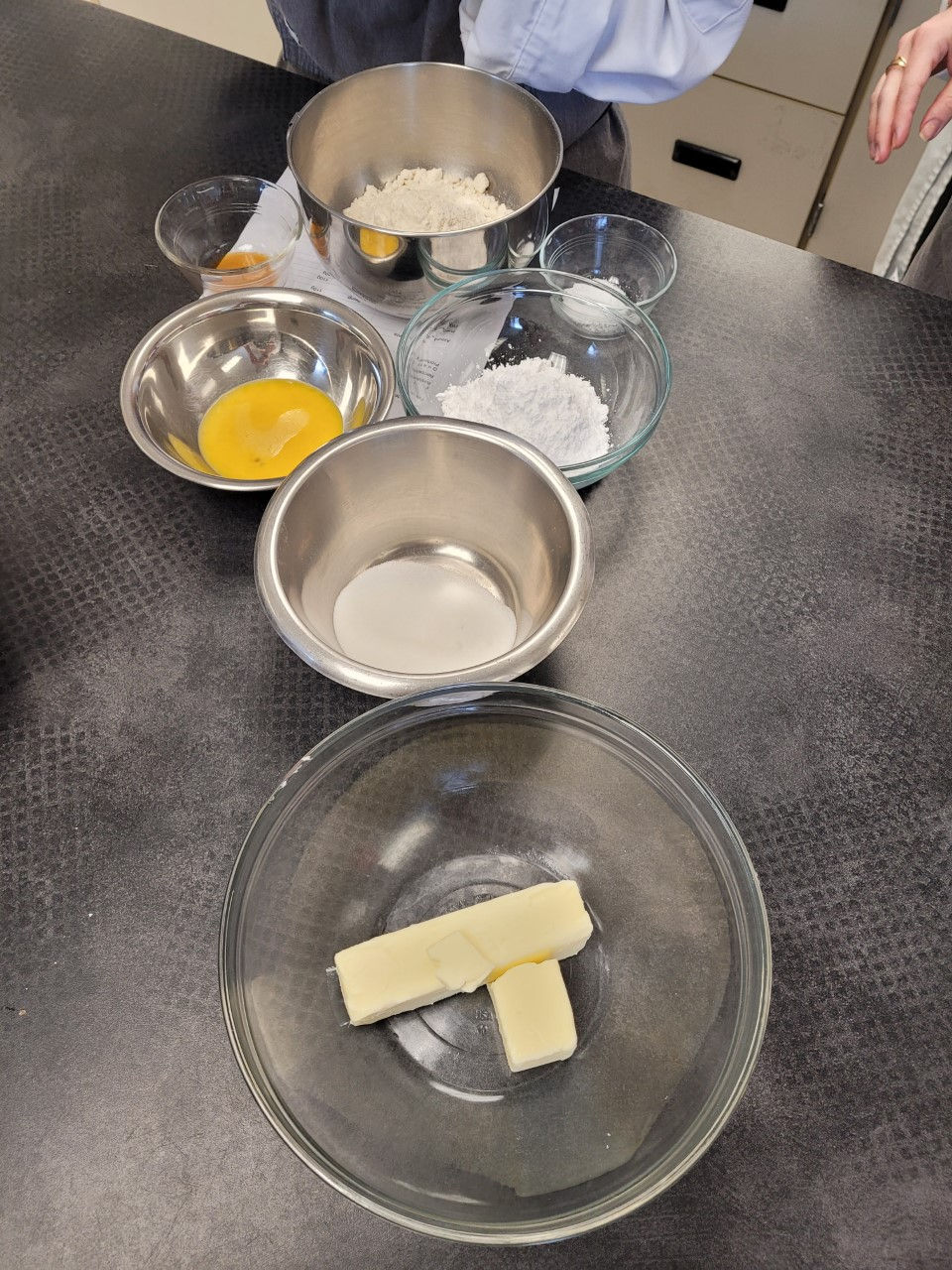
Stages of Lab




design. Yes, the cooking technique of the citrus bar did work. The texture of the citrus bar had a crunchiness and softness to it. The short dough added the crunch factor, while the curd added the softness. The taste of the bar was sweet and tart, and the lemon flavor overpowered the orange flavor. The appearance of the bar had a slightly thinner crust and curd layer. The lemon’s yellow color was bright and appealing to look at.
Evaluation
The ice cream took a longer time to churn than expected. One reason may be that there was too much frozen guava added to it. The overall mixture may have become liquidity causing it to take longer to mix. One possible solution is to add less guava puree, which would add less liquid to the overall mixture. It was harder than expected to get the checkerboard design at first. The dough layers were too thin, so it created more of a striped pattern than a checkerboard. We were able to achieve the checkerboard design by making the cuts thicker and alternating the doughs in a different orientation. Next time, we would need to make the layers slightly more thick , so the squares are more prominent. The rolls of dough were too small, so the overall size of the cookies were smaller than expected. For next time, the layers can be thicker, so the roll of dough will be a bigger roll. The cookies had a tenacity to spread during the baking process. The dough did not chill long enough, so it caused the dough to spread. Next time, it would be best to chill the dough at a longer timer, so the butter can solidify more. It will hold its shape better. The citrus bar's short dough was too thin, so one way to fix this would be to make more of the dough. More dough would also help cover the sides of the pan better, which will hold the curd better.
Conclusions
I feel I did the best at creating the icebox cookies, as I achieved the checkerboard effect. It took a few trials to figure out pattern, but the checkerboard pattern did show up. Making the icebox cookies took longer than expected, and creating patterns in pastry dishes are challenging. In order to execute the icebox cookies properly, it is best to not rush the process. Time allocation of each task is important to keep the best shape. Preparing more food items than needed is important in case something is dropped or broken. The extra amounts would create a safety net that ensures everyone can taste the dish. I feel I need to practice more on plating and better execution of the icebox cookies. Since, we eat with our eyes, presentation is important and the overall look contributes to how appetizing something is.