
WEEK 13
Introduction
Cookery Topic:
Custards, Puddings, Mousses & Soufflés
Cookery Method:
This week, we will be learning how to make crème anglaise, which is the base for custards. The custards would be a crème brulee or flan. The pudding could be a panna cotta, bread pudding, vanilla or chocolate pudding. Mousses and soufflés can be savory or sweet. The custards, puddings, mousses, & soufflés have similar bases, but they vary in a few ingredients and purposes. Some can be served by themselves like a pudding, while others can also be used as fillings like a custard.
Dishes:
Guava Crème Anglaise, Lemon and Coconut Panna Cotta, Mushroom & Cheese Soufflé, Chocolate Mousse, and Chocolate Indulgence
Prior Knowledge:
I have only plated crème brulees at a previous job, but I did not make them. I have not made a crème anglaise, panna cotta, soufflé, and mousse before.
Learning Objectives:
This week, we will "prepare boiled puddings and range-top custards. Prepare baked and steamed puddings. Prepare Bavarian creams, mousses, and cold charlottes. Prepare hot dessert soufflés." ( Gisslen, 2021, pg. 527) We will learn how time will affect a soufflé. We will also learn how gelatin will fasten the setting process for the custards and mousses.
Gisslen, W. (2021). Custards, Puddings, Mousses, and Soufflés. In Professional Baking (8th ed., p. 527). Wiley.
Background
Scientific principles:
Soufflés contain beaten egg whites, which lighten the batter mixture. Then, the soufflé is baked. "Baking causes the soufflé to rise like a cake because the air in the egg foam expands when heated. Toward, the end of the baking time the egg whites
Inspiration

Matsoukas, G. (2019, March 31). Key Lime Coconut Panna Cotta. Running to the Kitchen®. Retrieved April 6, 2022, from https://www.runningtothekitchen.com/key-lime-coconut-panna-cotta/

Furniss, J. (2022, February 14). Top Tips From Southern Cooks to Make Perfect Chocolate Cakes. Allrecipes. Retrieved April 6, 2022, from https://www.allrecipes.com/article/make-best-chocolate-cakes-with-tips-from-southern-cooks/

Meredith, & Parisi, G. (2013, December 7). Mushroom and Chèvre Soufflés. Food & Wine. Retrieved April 6, 2022, from https://www.foodandwine.com/recipes/mushroom-and-chevre-souffles
coagulate, or become firm." ( Gisslen, 2021, pg. 563) Soufflés are not as stable as cakes, they fall shortly after leaving the oven. They need to be served immediately. The soufflé contains three components: base, flavoring ingredients, and egg whites. The most common base used in dessert soufflés are " heavy, starched thickened preparations, such as pastry creams or sweetened white sauces. If egg yolks are used, they are added to the base." ( Gisslen, 2021, pg. 563). Then ,"flavoring ingredients are added to the base and mixed in well. Whenever possible, egg whites should be whipped with some of the sugar. This makes dessert soufflés more stable. Butter soufflé dishes well and coat them with sugar. "(Gisslen, 2021, pg. 563). The sugar helps with adding height, as the soufflé batter grabs at the sugar.
Origin:
There are cornstarch puddings and egg -and- milk custards. In the history of custards and puddings, " mixes are a relatively recent invention." ( Encyclopedia, n.d) Baked egg and milk custards is from ancient times, where a surviving recipe originates from Rome. " The combination was also liked in the Middle Ages, when pastry was used to contain the mixture. The word "custard" comes crustade, meaning a single crust pies. Sugar, spices, vine fruit, almonds, and ground meat were added to custards. " ( Encyclopedia, n.d) A distinction between and sweet and savory food was not made until the 17th century ( the idea of a savory custard evolved into the 21st century quiche Lorraine. ) " Possets, warm drinks of eggs, cream, wine or ale, sweetened and spiced, were also made. They were popular in the seventeenth century , and may have influenced ideas about dessert sauce, as well as being ancestors of eggnogs. With or without pastry, custards were popular in eighteenth- century Europe. In England, rich ones flavored with almonds, pistachios, or orange flower water were called creams. Custards also acquired a new role as a base for ice creams, which later become important in North America. Elsewhere, elegant custard desserts were developed, such as the egg yolk and cream crème brulee, with a crust of caramel sugar, and petits pots de crème, cooked in little cups or ramekins (itself Flemish word which originally meant 'little cream'). Custards cooked in molds lined with caramel sugar- crème caramel, Spanish leche flan- later became clichés of restaurant cookery in the twentieth century. " ( Encyclopedia, n.d) By the 19th century, the idea of custards and puddings differed from the ones in England. "The extraction of cornstarch in 1842 in New Jersey; by 1850, food- grade starch was being produced. secondly, in Birmingham, England, in 1844 a pharmacist named Albert Bird devised custard powder, a flavored starch mix for his wife who was fond of custard but allergic to eggs. Convenience puddings appeared in the mid 1920s, when the Jell-O Company introduced a chocolate mix for use in institutions. Consumers had to wait until 1934 until they could buy a similar product sold as Walter Baker's dessert. Instant mixes came onto the market in the 1950s." ( Encyclopedia, n.d)
Methods used:
For the chocolate indulgence cake, Chocolate Mousse and Italian Meringue have to made. On way to "define a mousse as any soft or creamy dessert made light and fluffy by the addition of whipped cream, beaten egg whites, or both. " ( Gisslen, 2021, pg. 543) Bavarians and chiffons would also fall into the mousse description. They are served as mousses, " but with the gelatin reduced or left out so the mousse is softer." (Gisslen, 2021, pg. 543) The bases can be chocolate or pureed fresh fruit. The preferred sequence of steps is to fold the egg whites first then, add the whipped cream. Egg whites need to be folded into the hot base, so they can coagulate or cook, "making the mousse firmer and more stable. Whipped cream should never be folded into hot mixtures because it will melt and deflate."( Gisslen, 2021, pg. 543) To make the mousse with gelatin, it is best to soften the gelatin first. Then, the next step is to make a syrup by boiling sugar, water, and glucose. The syrup's temperature should be cooked to 245 F (119 C). Next, "whip the egg yolks until thick and pale. Gradually beat in the hot syrup. Add the gelatin and beat until dissolved, continue whipping until cold. Fold the melted chocolate into the egg yolk mixture." ( Gisslen, 2021, pg. 554) After, the heavy cream is whipped to soft peaks and fold in. Finally, the Italian meringue is folded and pour into molds. They will need to be chilled, so they can fully set.
Variations:
The custards are categorized into two kinds: stirred custard and baked custard. Crème anglaise and pastry is considered a stirred custard. There are four types of puddings: cornstarch pudding, cream puddings, puddings bound with gelatin, and crémeux. One of the most popular desserts that is considered a pudding bound with gelatin is panna cotta. Crémeux uses crème anglaise as the base and gelatin, butter, or chocolate are the thickening/ binding agent. Steamed puddings are a winter food item, and steaming is the least common cooking method. Mousses can be savory or sweet, and they can be served on their on own or used as a filling for other desserts. (Gisslen, 2021, pg. 528-529)
Encyclopedia. (n.d.). Custard And Puddings | Encyclopedia.com. Retrieved April 6, 2022, from https://www.encyclopedia.com/food/encyclopedias-almanacs-transcripts-and-maps/custard-and-puddings
Gisslen, W. (2021). Custards, Puddings, Mousses, and Soufflés. In Professional Baking (8th ed., pp. 528,529,543,554,563). Wiley.
Recipes

Guava Crème Anglaise will be on top of the panna cotta
Plan of Work
_edited.jpg)
Reflection:
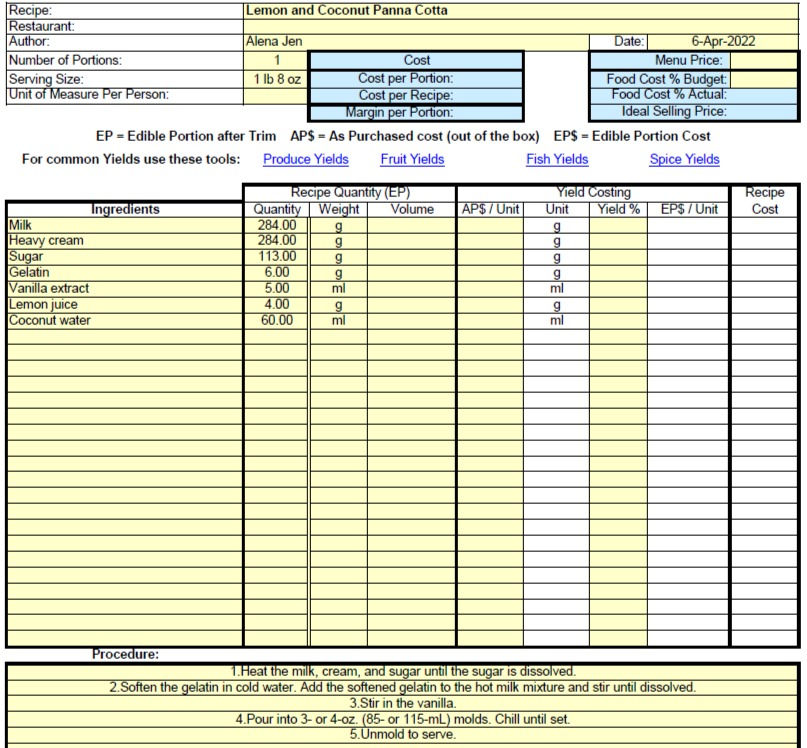
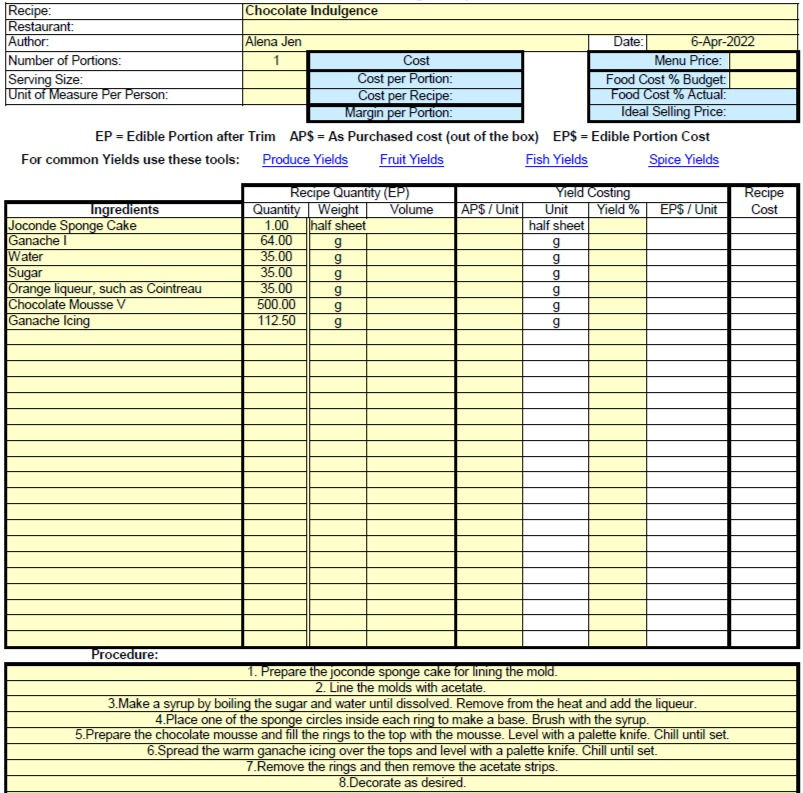
Food Costing

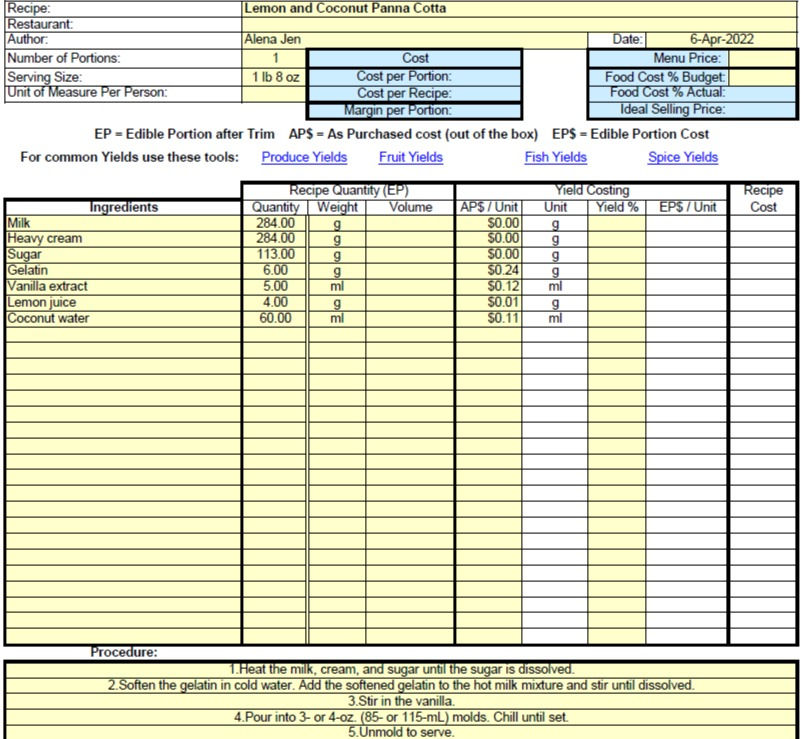
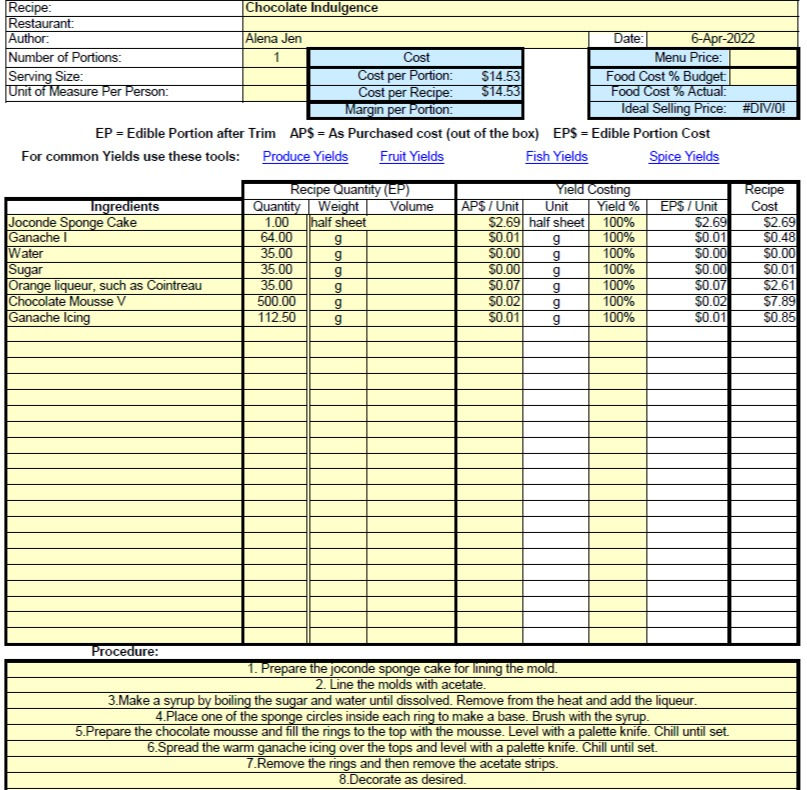
Final Plating


Stages of Lab




Results
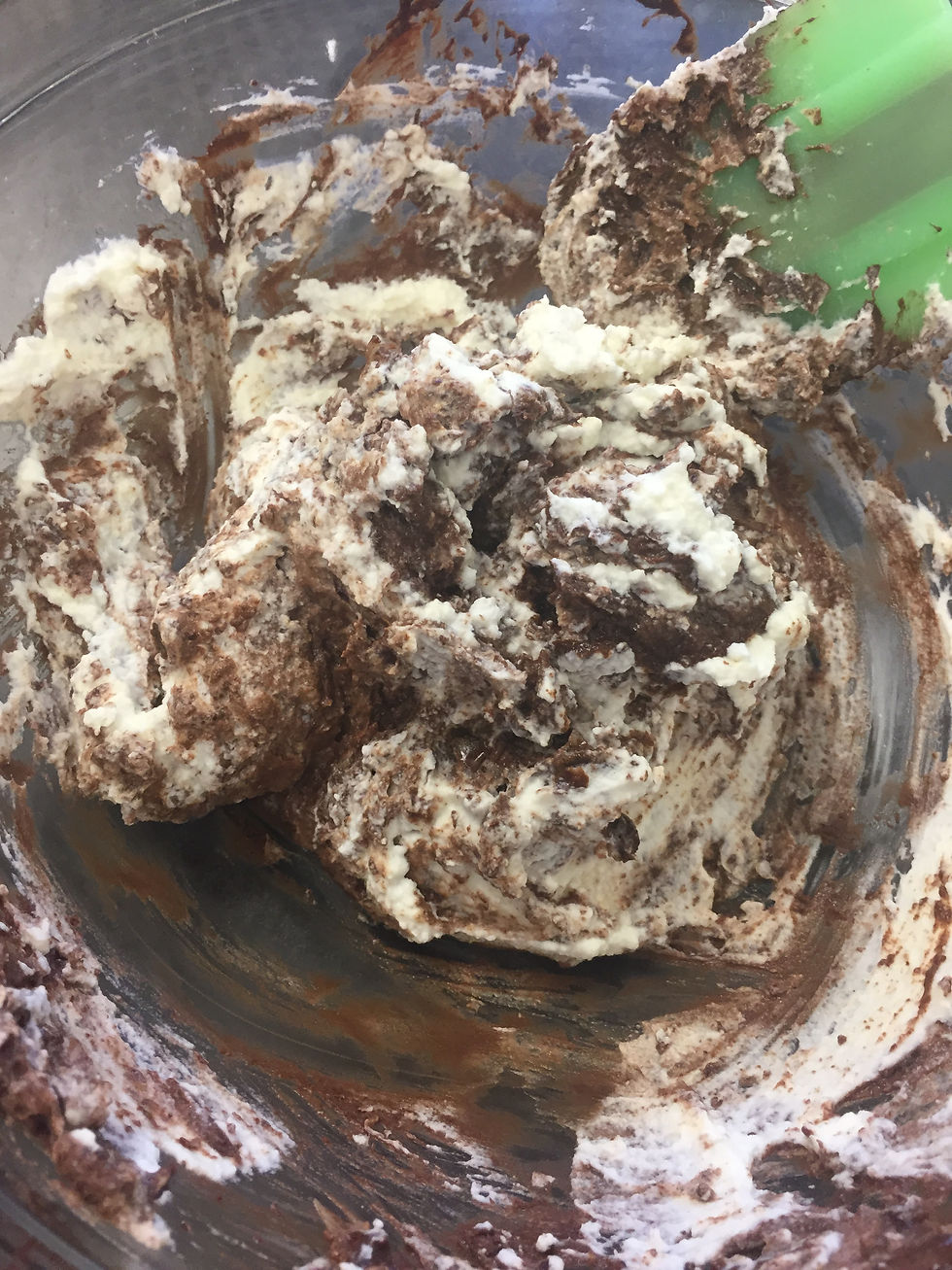
The cooking technique did not work for me, because I made a few mistakes during the entire process. The texture of the of chocolate mousse was gritty, but the desired texture is smooth and light. The taste of the mousse is sweet, and the flavor of the chocolate is the most prominent flavor. The appearance of the mousse was light brown, but there a few clumps of gelatin and chocolate that are not fully incorporated. The cooking technique of the soufflé did work. The texture of the mushroom and queso fresco was fluffy and light. The taste of the mushroom and queso fresco is salty and sweet, and the flavor of the mushrooms and queso fresco was not really strong. The sugar in the soufflé made the soufflé taste more sweet than savory. The appearance of the soufflé did have a lot of height, but it did fall over time. The top had a golden brown top, and the insides of the soufflé were a light golden color. The cooking technique of guava crème anglaise did work. The texture of the crème anglaise had a milk- like thickness. The taste of crème anglaise was sweet, and the guava flavor was very dominant. The appearance of the crème anglaise was a peachy pink color, which gave a lot of contrast to the panna cotta. The lemon and coconut panna cotta texture’s was similar to jello, but it was still very soft. The texture of the toasted coconut added a little bit of crunch to the overall texture. The taste of the panna cotta was sweet & slightly acidic and the most prominent flavor was the lemon. The coconut flavor was not as strong, but the coconut shavings added more coconut flavor. The appearance of the panna cotta was mostly white with specks of yellow from the lemon zest.
Evaluation
The chocolate mousse did not turn out very well, as I had hand whipped all of the steps. For next time, it would be better to whip it in the mixer, so more air is incorporated and the texture will be a lot lighter. I was not fast enough in progressing to the next stage, so the mixture became to cold. When it became too cold, the gelatin and chocolate did not fully melt. Next time, I have to be quicker at every stage. The gelatin was added to the mixture as soon as it was squeezed out, and the delay caused the gelatin to not fully incorporate. For next time, it is best to put in the gelatin as soon as all of the water has been squeezed out of it. I had hand mixed the mixture when the gelatin was added, so there were still bits of gelatin in the overall mixture. Next time, it would be better to just use the electric mixture as it could mix it at a faster rate. It would break down the gelatin more than hand whipping it. The mushroom and queso fresco was too sweet and not savory enough. One reason may be there was too much sugar and not enough salt to balance out the sweetness. For next time, we could cut back on the sugar in the meringue and add more salt to toppings and egg mixture. Another way to combat the sweetness would be to coat the dishes with salt instead of sugar. The panna cotta’s texture was too soft, so it did bot fully firm up. One solution would be starting it earlier in the lab, so there is more time for it to set.
Conclusions
The learning objective I did the best was making the Italian meringue for the mousse. It took a few times to get it right, but I eventually got the mixture to the right temperature. I was able to whip the egg white, sugar, and syrup at the right peak stage. I learned that making the syrup for the meringue is harder than expected, and one second does count for this process. I learned that time is important in any environment, whether it is in a kitchen or office, I feel I still need to work on my sugar skills, as the syrup constantly crystallized on me.