WEEK 2
Introduction
Cookery Topic:
Yeast Dough I:
Lean Yeast Dough- Straight Method
Cookery Method:
The building blocks for any bread is flour, water, and yeast. Baking is the main cooking method. Fermentation of the yeast a crucial part in making dough.
Inspiration
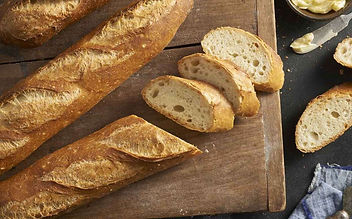
Hamel, PJ. “Classic Baguettes.” King Arthur Baking, 2022, https://www.kingarthurbaking.com/recipes/classic-baguettes-recipe.
Dishes:
French Bread ( Straight Method) , Soft Rolls, and Milk Bread
Prior Knowledge:
I have only made bread once, it was unsuccessful as the water was too hot. It killed the yeast, so the bread was not rising properly.
Learning Objectives:
"Describe the principal types of yeast-raised products.
Describe the 12 basic steps in the production of yeast goods. Explain how to judge the quality of yeast goods and correct defects in them." ( Gisslen 109)
"Explain the mixing methods for straight doughs, and prepare straight doughs.
Mix doughs using appropriate mixing times and speeds, based on the three basic techniques for developing yeast doughs.
Describe the factors affecting dough fermentation and how to control them.
Make up and bake a variety of yeast dough products." ( Gisslen 123)
Gisslen, Wayne. “Understanding Yeast Doughs.” Professional Baking, Wiley, Hoboken, NJ, 2022, p. 109.
Gisslen, Wayne. “Lean Yeast Doughs: Straight Doughs.” Professional Baking, Wiley, Hoboken, NJ, 2022, p. 123.

Wheaton, Hazel. “9 Shaped Dinner Roll Ideas That'll Make You Look like a Pro.” Taste of Home, Taste of Home, 22 Apr. 2019, https://www.tasteofhome.com/collection/ways-to-shape-dinner-rolls/.
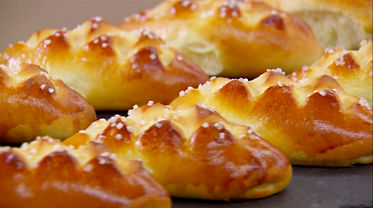
Richard. “Pain Au Lait Recipe.” PBS, Public Broadcasting Service, https://www.pbs.org/food/recipes/pain-au-lait/.
Background
Sketches
Scientific principles:
Bread making can be successful with understanding in two principles: gluten development and yeast fermentation. The biggest concern when baking bread is the gluten- forming proteins. "The gluten proteins are needed to give structure to baked goods. Bakers must be able to control the gluten. Glutenin and gliadin are two proteins found in wheat flour and smaller quantities , in a few other grains, such as rye and spelt. During mixing, the two proteins combine with water to create gluten. Gluten forms when hydrated glutenin and gliadin proteins uncoil and attach to each other to form long chains. During mixing. these proteins uncoil and attach to other to form long chains. During mixing, these protein chains gradually stretch and become intertwined, forming an elastic network called the gluten structure. Coagulation is the firming or hardening of gluten proteins, usually caused by heat. When the proteins are coagulating during the baking, they solidify into a firm structure. The selection of flours is important as the protein content will affect the gluten's strength. The fat used in baking is referred as shortening because it shortens gluten strands. Fats are tenderizers. Sugar is also a tenderizer that inhibits gluten development. Sugar absorbs the water so it won't hydrate the gluten. The amount of water can affect toughness or tenderness of the dough. The water hardness and pH can also affect the tenderness as well.
Yeast fermentation helps gluten development because the expansion of air cell by yeast stretches the gluten, just as mixing does. Leavening strengthens and tenderizes the product. Over fermented dough can result in undesired texture. " ( Gisslen 101-103)
Origin:
There was an archeological discovery of the oldest piece of bread in Jordan. "The leftovers of the Natufians, a hunter gatherer tribe that lived in the area 14,000 years ago- during the Epipaleolithic time- period between the Paleolithic and Neolithic eras. This discovery has changed the timeline of their way of life. It would meant that our ancestors learned how to bake , then they learned how to farm. " ( Zeldovich 2018)
Methods used:
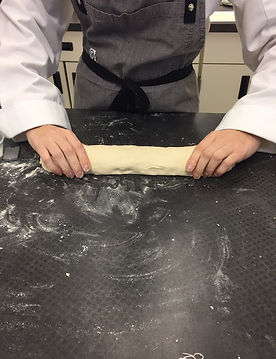
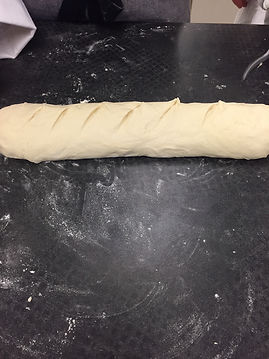
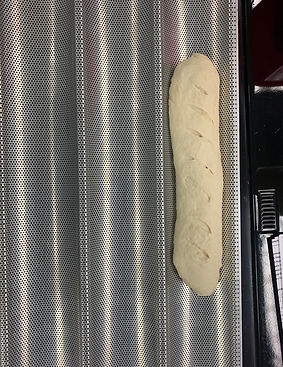
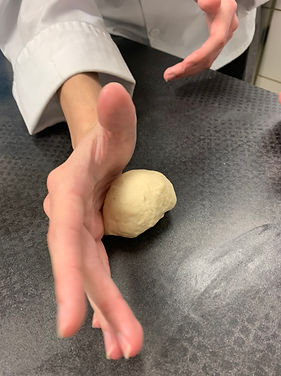
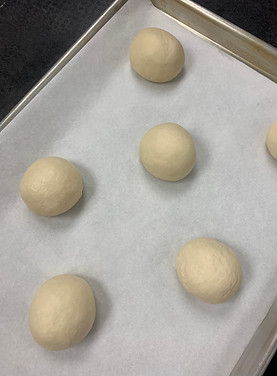
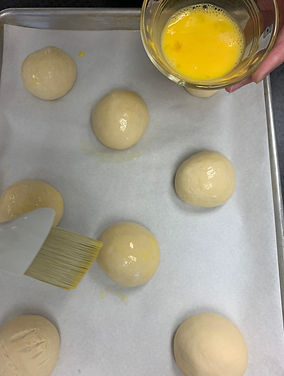
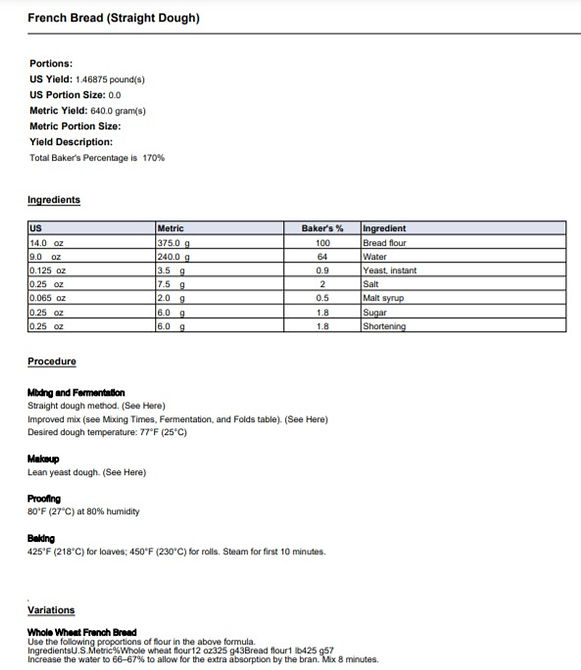
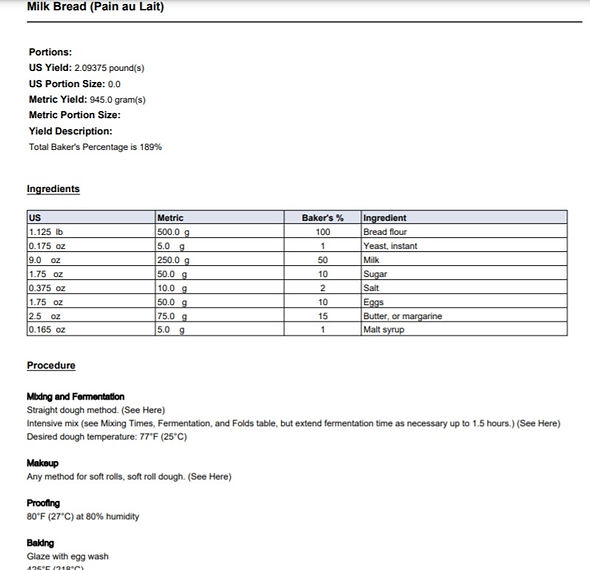
Making the yeast doughs, the stages of the process are : mixing and fermentation, makeup proofing, and baking. The main ingredients of making bread is flour, yeast, shortening ( fat ), and water. Additional ingredients such as salt, sugar, eggs, milk, and malt syrup would be added depending on the bread type. In the mixing and fermentation process, there is the straight dough method, mix method (includes mixing times, fermentation, and fold amounts). and desired dough temperature. The make up stage describes how certain shapes are made with the dough. The shapes can range from knots, twist, rolls, and other shapes. The proofing process will have varying temperatures and humidity levels depending on the dough type such as French bread ( straight method) is at 80 F ( 27 C) at 80% humidity. The final stage is the baking stage where French bread is 425 F for loaves and 450 F for rolls. French bread needs to be steamed for the first 10 minutes. However, the steaming is only necessary for crisp crusted breads like the French Bread. Soft crusted doughs such as soft rolls and milk bread go through the same stages but the mix method, desired dough temperature, makeup, and baking will change. "Soft crusted include milk ,eggs and higher percentages of sugar and fat." ( Gisslen 136)
Variations:
A variation of French Bread is Whole Wheat French Bread, where whole wheat flour and a smaller amount of bread flour is used. "Water is increased by 66- 67 % for extra absorption of the bran. " ( Gisslen 135)
A variation of soft rolls is cinnamon bread and raisin bread. The soft rolls can be formed into loaves. ( Gisslen 138)
Milk bread ( pain au lait) can be shaped in a multitude of shapes like tied or knotted rolls ( Single knots , Figure - eight , Double- knot, Braided) ,Sawtooth, Crescent, Pan, Parker house, Butterflake, Cloverleaf, Pan loaves, and Pullman loaves. (Gisslen 139, 152-155)
Sources:
Gisslen, Wayne. “Basic Baking Principles.” Professional Baking, Wiley, Hoboken, NJ, 2022, pp. 101–103.
Gisslen, Wayne. “Lean Yeast Doughs: Straight Doughs.” Professional Baking, Wiley, Hoboken, NJ, 2022, pp. 135–139.
Gisslen, Wayne. “Lean Yeast Doughs: Straight Doughs.” Professional Baking, Wiley, Hoboken, NJ, 2022, pp. 152–155.
Zeldovich, Lina. “14,000-Year-Old Piece of Bread Rewrites the History of Baking and Farming.” NPR, NPR, 24 July 2018, https://www.npr.org/sections/thesalt/2018/07/24/631583427/14-000-year-old-piece-of-bread-rewrites-the-history-of-baking-and-farming.
Recipes
_edited.jpg)
_edited.jpg)
_edited.jpg)
Plan of Work
_edited.jpg)
Reflection:
Food Costing
_edited.jpg)
_edited.jpg)
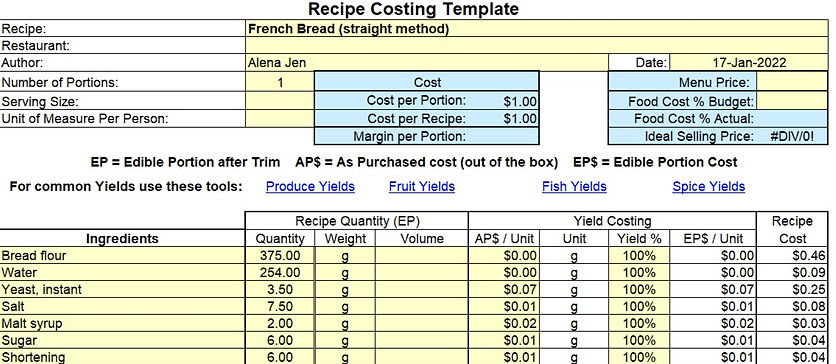
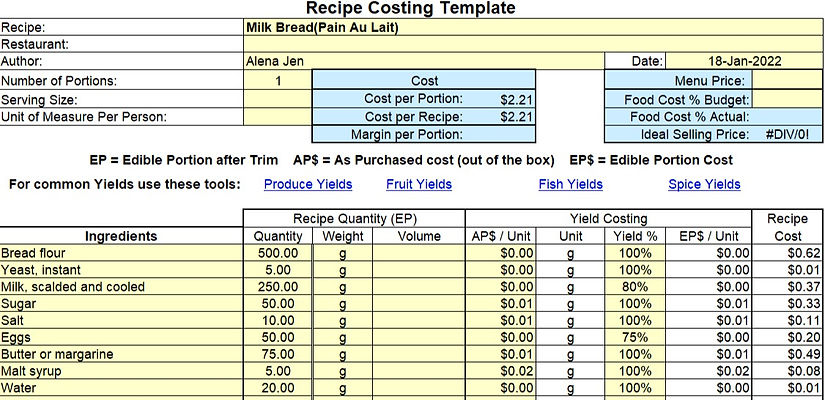
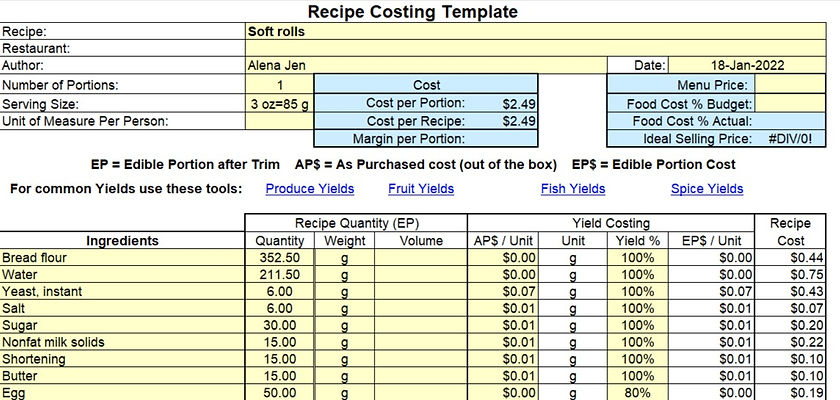
Note: The AP$/ Unit is more than what is shown, but the amount is rounded to two decimal places.
Results
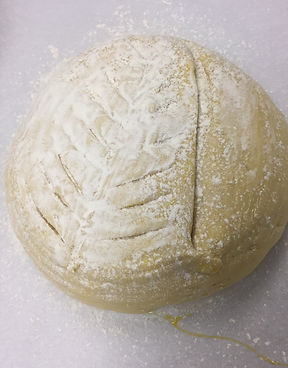
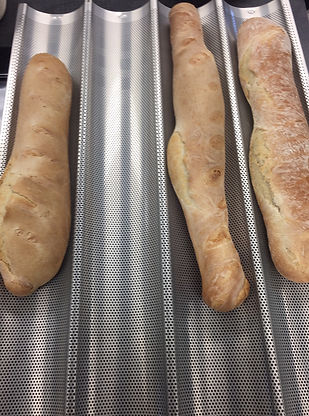
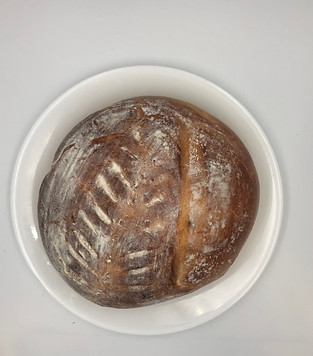
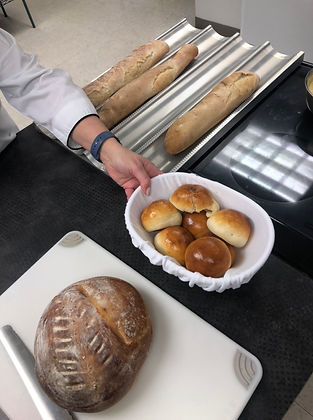
All of the cooking techniques did work. The French Bread had a harder crust than the Milk Bread and Soft Rolls. The crumb texture was soft and tender. The taste of the French Bread was slightly saltier than sweet. The flavor of the yeast had a strong presence. The appearance of the French Bread had the smallest bubbles in the crumb layer. The Milk Bread texture had a slightly softer crust and a soft crumb. The taste was slightly sweet, and the flavor was neutral. The inside of the bread was the white with a few larger bubbles in the crumb. The texture of the Soft Roll was soft and dense. The taste were neutral with not much of a yeast flavor. The appearance of the crumb was white with an golden brown crust.
Evaluation
The steaming of the French Bread did work because it created more humidity. The humidity is essential for keeping the bread moist and not drying out. the loaf was slightly smaller than the rest, so one way to solve this is shape it longer and/or make more dough. The baking of the Milk Bread was successful, but the bottom of the bread busted. One reason it may have busted was the slit on the top was not cut deep enough, so the carbon dioxide released from the bottom. This can be fixed by creating a deeper slit on the top or mote slits. We forget to add more flour on regards to more water being added into the dough. This can be fixed is calculating and adding more flour. The Soft Rolls technique did work, but the outside crust was a little too dark. This may have been caused by the convention oven temperature is not always accurate and it being in the oven for too long. This can be remediated by checking the oven temperature, using the smaller ovens, and decreasing the bake time.
Conclusions
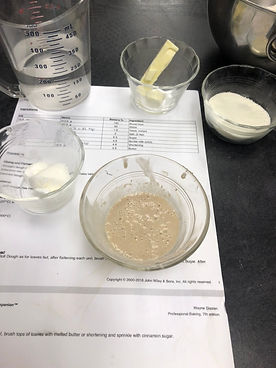
We were able to accomplish the learning objectives of changing the mixing times depending on bread type. We made sure the internal temperature of water stayed in the 95- 105 F as to not kill the active yeast. We weighed out all of ingredients to make sure that we had the precise amounts. I learned that patience is important in time sensitive, and there are some processes that cannot be rushed. Weather needs to be taken into account when making humidity sensitive pastries and other dishes.
Final Plating
Stages of Lab