
WEEK 3
Introduction
Inspiration
Cookery Topic:
Yeast Dough II
Cookery Method:
This week will be making bread through the sponge and dough method. The Sponge Method involves a pre- fermentation stage and fermentation stage.

Dishes:
French Bread (Sponge Method), Rustic Sourdough, and Pumpernickel Bread
French-Style Country Bread. (n.d.). King Arthur Baking. Retrieved January 25, 2022, from https://www.kingarthurbaking.com/recipes/french-style-country-bread-recipe
Prior Knowledge:
I have not made any bread using the sponge and dough method. I am aware that sourdough requires a starter, and a starter must be constantly feed to stay alive. Last week, we made yeast doughs with the straight method so, most of the ingredients will remain the same.
Learning Objectives:
"Explain the methods for preparing sponge doughs, and prepare sponge doughs and yeast pre-ferments. Prepare and maintain sourdough starters, and use them to mix doughs. Ferment and bake sponge dough and sourdough products." ( Gisslen 163) This week, the main objective is to learn how make bread using the sponge method, and how it will affect the overall texture, taste, and appearance. Learning about how artisan breads are made will give greater insight and appreciation of the entire process and final product.
Gisslen, W. (2021). Professional Baking (8th ed.) [E-book]. Wiley.
Sketch


Rustic Sourdough Bread. (n.d.). King Arthur Baking. Retrieved January 25, 2022, from https://www.kingarthurbaking.com/recipes/rustic-sourdough-bread-recipe

Turner, L. (2021, June 5). Pumpernickel Toasts with Smoked Salmon & Avocado Cream Cheese Recipe. Better Nutrition. Retrieved January 25, 2022, from https://www.betternutrition.com/recipes/pumpernickel-toasts-smoked-salmon-avocado-cream-cheese-recipe/
Background
Scientific principles:
"A poolish (or poolisch) is a thin yeast starter made with equal parts flour and water (by weight), plus commercial yeast. In other words, a formula for poolish is 100% flour, 100% water, and varying percentages of yeast, depending on the desired speed of fermentation.
To contribute maximum flavor, a poolish is made with only a small quantity of yeast and given a long fermentation at room temperature." ( Gisslen 165) The poolish will bubble and get larger in volume, and it will reach it's peak and get smaller. This is a slow fermentation that can least many hours at a high quality, but if it ferments too long the acidity will go up while the quality will go down. There is only a small amount of yeast needed since there is such a high water content. However, more yeast may need to be added to leaven the dough completely. ( Gisslen 165)
Origin and history:
The sponge and dough method became popular during the 70s and 80s after poor results from using the continuous mixing method. This caused a shift in mindset for bakers to give more time to ferment, naturally mature, and improve the quality. (Sponge and Dough | Baking Processes, 2021) This method is used in North America, Asia , and Central Europe. It can be utilized in a small production to a large commercial bakery.
Methods used:
There is an extra step during the mixing stage of the final dough called autolyse, which "is helpful to create a good gluten structure."( Gisslen 167) The first step is to combine the flour and water and mix at a low speed. At the end, a dough should be formed, then should be left to sit for 20- 30 mins. During the autolyse, the flour is absorbing all of the water, while the enzymes interact with the proteins. This makes the dough easier to handle and a better gluten structure is formed. Yeast and salt would not be added until after the sitting time as, it would mess up the entire process. ( Gisslen 167)
Variations:
Depending on the type of bread, the baker's percentage will vary slightly, especially in the yeast. Biga is a starter for stiff- pre ferments, while a Leavin- Leuvrre can sometime be associated with thin- pre ferments. ( Gisslen 166) The yeast can differ from wild, instant, active, or fresh, which could affect the flavor of the bread. The shape can also vary where it be a flatter bead such as focaccia bread to a sourdough loaf.
Gisslen, W. (2021). Professional Baking (8th ed.) [E-book]. Wiley.
Sponge and Dough | Baking Processes. (2021, November 8). BAKERpedia. Retrieved January 26, 2022, from https://bakerpedia.com/processes/sponge-and-dough/
Recipes

_edited.jpg)
_edited.jpg)
Plan of Work
_edited.jpg)
Reflection:
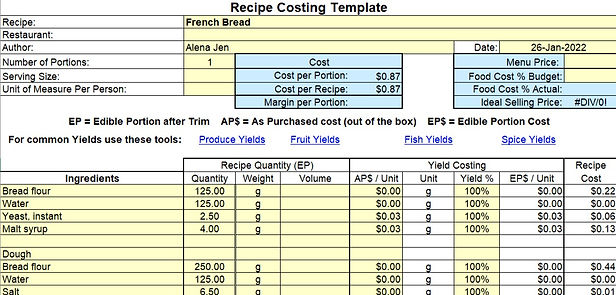
Food Costing
_edited.jpg)
Final Plating

_edited.jpg)
Results
The sponge method worked well with the French Bread, but the sponge method did not work well with the Rustic Sourdough and Pumpernickel Bread. For the French Bread, the outside texture was still crunchy, but it was not as hard as last's week's French Bread. Last week, we used the straight method. The sponge method made the crumb texture even softer. There is a slight saltiness to the French Bread as there is more salt than the malt syrup(sweetness). There was more airiness mouthfeel ,and there were larger bubbles present in the crumb. For the Rustic Sourdough, the texture was a lot denser almost cake-like. The crust and crumb were difficult to cut through as the bread was so dense. The taste of the sourdough is slightly sour, where the flavor of the yeast is prominent. The appearance of the outside was slightly darker in the air bubble portion. The appearance of the first layer of the crumb looks almost undone, but the internal temperature already reached over 200 F. For the pumpernickel bread, the texture of the crust was crunchy but it was almost too hard. The crumb texture was soft and dense. The taste of the pumpernickel was slightly sweeter with the molasses and malt syrup. The flavor was slightly tangy, dense, and hearty. The appearance of the Pumpernickel was dark and, it had more height than other pumpernickel breads in class.
Evaluation
Steaming the breads for the first 10 minutes worked well, especially the French Bread, The steaming bread in the first 10 minutes keeps the crust soft, expands the bread, and caramelizes the crust. (Christensen, 2009) We also proofed the bread in the smaller ovens that were at 350 F, which helped increase the size. The sponge method did not work for the Rustic Sourdough as we did not have enough sourdough starter, so 80 grams of of bread flour, and 80 grams of water were added to the 80 grams of the starter. The starter needs at least 8 hours when the additional ingredients were added to fully ferment. After the dough was formed, the proofing needs another 3- 4 hours, and there is not enough class time to complete the proofing. We were rushing the process ,and everyone's bread turned out the same way. One way to improve the results in using a different sourdough recipe that would be suitable in a shorter time frame. There was not enough starter for the last group, so another group may have forgotten to tare the scale. There was a darker spot on the crust, so I could rotate more so that it has a more even color. The Pumpernickel Bread did not work as well as I put in the wrong flour, and I put in bread flour than the clear flour. I added all the flour at once, rather than gradually adding the flour, which caused it to be too dry. We used dark rye flour rather than the rye meal, which may have affected the overall texture. Next time, I will make to fully mix all of the wet ingredients before adding the flour, molasses, and malt syrup. I added 230-240 ml of water to make it moist and easier to handle. However, the dough was extremely tight, so I left it to rest for a few minutes before kneading a couple of minutes. For the future, I would bake at a higher temperature, then lower the temperature to prevent excessive browning.
Conclusions
I feel I did the best at executing the French Bread as the texture, flavor, and overall appearance were appealing. The crust was crunchy, crumb had larger bubbles, and the color was not golden brown. The steaming of the first 10 minutes and checking the internal temperature every 15-20 mins to make sure the internal temperature reached 200 F. Time management is crucial especially involving multiple projects that have the same deadline. The tasks are time sensitive, so everything in a timely manner will lead to greater results. There are some tasks and projects that cannot be rushed, and allocating enough time is crucial for longer processes and projects. I need to practice more on multitasking. Doing more than one task can help quicken the overall process, and it could cause less delay.
Christensen, E. (2009, February 17). Food Science Tip: Add Steam When Baking Bread. Thekitchn. Retrieved January 29, 2022, from https://www.thekitchn.com/food-science-tip-add-steam-whe-76586
Stages of Lab

French Bread
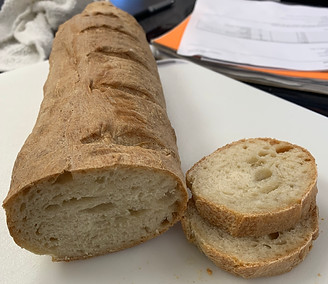
Cross Section of French Bread


Combined ingredients of Rustic Sourdough
Proofed Rustic Sourdough
Cross Section of Rustic Sourdough

Crust of Rustic Sourdough

Pumpernickel Bread