
WEEK 4
Introduction
Cookery Topic:
Yeast Dough III
Cookery Method:
This week, we are doing enriched breads, where the fat, milk, and eggs are at a higher portion than the flour, yeast, and water. We will be making sweet rolls, and we will be learning the lamination method for the croissants.
Dishes:
Sweet Roll Dough, Brioche, and Croissant
Prior Knowledge:
I have never made sweet rolls, brioche, and croissants. In the last two weeks, I did learn how to use the sponge method and straight dough method. The sponge method requires two fermentation stages, while the straight method only requires one.
Inspiration

Bell, J. (2019, December 8). Best Cinnamon Rolls Recipe. Cooking Classy. Retrieved February 2, 2022, from https://www.cookingclassy.com/better-than-cinnabon-cinnamon-rolls/
Learning Objectives:
This week, we will "produce simple sweet doughs, produce laminated yeast doughs, and make up a variety of products using sweet doughs, laminated doughs, and sweet-dough fillings and toppings." ( Gisslen 191) Sweet roll dough, brioche, and croissants are labor intensive, and it would be great to learn how to make enriched breads.
Gisslen, W. (2021). Professional Baking (8th ed.). Wiley.

Sketch
Classic Brioche. (n.d.). King Arthur Baking. Retrieved February 2, 2022, from https://www.kingarthurbaking.com/recipes/classic-brioche-recipe

Background
Scientific principles:
In enriched breads, "the high percentage of fat and sugar inhibits fermentation. The sponge method is often utilized, so the fermentation process can occur before the fat and sugar are added. The major exception is regular sweet dough, where the fat and sugar content is lower. The quantity of yeast is also increased. High levels of fat and eggs hinder gluten development, so the intensive mixing technique is used, to produce gluten strength. Once the gluten is developed, then the rest of the fat is added to the dough." (Gisslen 192).

Baker’s Croissants. (n.d.). King Arthur Baking. Retrieved February 2, 2022, from https://www.kingarthurbaking.com/recipes/bakers-croissants-recipe
Origin:
Lamination of dough emerged when Viennoiserie baked goods were created in Europe. Viennoiserie is the midpoint between pastry and bread. The two major classes of laminated or non laminated . Examples of laminated Viennoiserie include croissant, puff pastry, and Danish, while versions of non- laminated Vienoiserie include brioche, Pan d' Oro, and Gibassier. The lamination is the process of creating alternative layers of dough and "roll in fat" ( butter, hard fats, margarine, shortening) to create all of the flaky layers. There are three lamination methods: Three fold ( English) method, Four- fold( book fold) method, also known as double- turn method, and envelope method. (Dough Lamination, 2021)
Methods used:
For the sweet roll dough, the modified straight dough method is utilized. The steps of the modified straight dough method are:
-
"If using fresh or active dry yeast, soften the yeast in part of the liquid, using a separate container. If using instant dry yeast, mix it with the flour.
-
Combine the fat, sugar, salt, milk solids, and flavorings and mix until well combined, but do not whip until light.
-
Add the eggs gradually, but as fast as they are absorbed.
-
Add the liquid; mix briefly.
-
Add the flour and yeast. Mix to a smooth dough" ( Gisslen 192)
Variations:
For the sweet roll dough, there are crumb buns, filled buns, cinnamon raisin rolls, cinnamon rolls , pecan maple rolls, caramel rolls, caramel nut rolls or pecan rolls, and Danish spirals. ( Gisslen 211-213)
For the brioche, the makeup could be different where it's a brioche doughnut, beignets, and loaves, For the croissants, there can be jam, chocolate, or cream fillings. Croissants can also act as the bread component in a sandwich.
Dough Lamination | Baking Process. (2021, September 8). BAKERpedia. Retrieved February 2, 2022, from https://bakerpedia.com/processes/dough-lamination/#:%7E:text=Perhaps%20the%20lamination%20of%20dough,in%20sugar%2C%20butter%20and%20eggs.
Gisslen, W. (2021). Professional Baking (8th ed.). Wiley.
Recipes
_edited.jpg)
_edited.jpg)
_edited.jpg)
Plan of Work
_edited.jpg)
Reflection:
Food Costing

_edited.jpg)
_edited.jpg)
Final Plating


Results
The cooking techniques worked for sweet roll dough, but it did not work as well for the brioche. We were unable to finish the lamentation of the croissants ,so we will be finishing them next week. The sweet roll dough had a fluffy crumb texture , and it was dense. Before the baking process, the dough was sticky, The taste was sweet, as the sugar added a lot of sweetness to the roll. The flavor was buttery and sweet, where the sugar is the most dominant flavor. The butter, milk, and eggs contribute to the richness of the sweet roll. The appearance of the crumb are small, but there are some medium sized air pockets. The appearance of the crumb is compact, which would contribute to their density. The brioche's texture was soft, but it was still dense. There lightness mouthfeel when eating the brioche. The taste of the brioche is not as sweet, and it is more neutral. The flavor is buttery, where the butter is the most prominent flavor. The appearance of the crumb texture is compact, where there a few places that have larger gaps,
Evaluation
For the sweet roll dough, the modified straight method worked well, as we had enough time to do all of the steps. We did not need to rush the process, and the percentage of sugar was more 12% , so it was crucial that the osmotolerant yeast was used. Regular yeast would become inactive with high sugar content. I would approve the income of doing a different makeup and creating the correct shapes for the sweet roll dough. We had done shapes meant for yeast rolls, and tried to apply to the sweet rolls. Next time, the sweet rolls can be cinnamon rolls, Danish spiral, rosettes, pinwheels, and other shapes. We forgot to egg wash the outside, so it was very dull looking. Next time, we will do multiple egg washes as it is common practice for unlaminated and laminated breads. For the brioche, the initial poolish for the class did not work, so each group had to make their own. A poolish needs a few hours to ferment, but we had to quicken ours and use it in a shorter time frame. The brioche was harder to handle ,as it was extremely sticky. A longer time for the poolish and chilling would reduce the stickiness. Our mini brioche were in the oven for 17 minutes, but the 17 minutes is too long. The outside crust of the brioche was close to getting burnt, so we will reduce the baking time by 2-3 minutes. The initial attempt to fill our brioche with coffee pastry cream did not work. We could not fill it from the bottom, as the bottom was too dense. However, we were able to fill it in the middle section, by cutting a slit and inserting the cream that way. There was enough air pockets in the middle to accommodate the cream. The cream may be better suited for the sweet roll dough or we could fill it in from the top of the brioche. For the croissants, we were able to do all the steps up until the rolling in stage.
Conclusions
Based on the learning objectives, I feel I did the best at being able to learn how to make enriched breads. We were able to divide and conquer our recipes in the time given to us. Our brioche turned out well, as we made uniform mini brioche bread. that weighed exactly 36 grams each. We egg washed after proofing, which contributed to making the crust golden brown. The additional skills and knowledge that I learned outside of the objectives is that you egg washing is crucial for creating a more caramelized color, and it makes it more appetizing. Egg washing can be used in other pastries. I cannot rush every process., and taking the right amount of time yields better results. I still need to work on being more creative in how to make something standout. A recipe can only be a guideline, but it is up to an individual's creativity to make it more.
Stages of Lab

Mixing stage of the sweet dough roll

Fermentation of sweet roll dough

Baked stage of sweet roll dough

Baking sweet roll dough

Crumb texture of the sweet roll dough

Croissant dough on the left, pounded butter on the right

Rolling dough and butter layer together, one time

Fold of the croissant
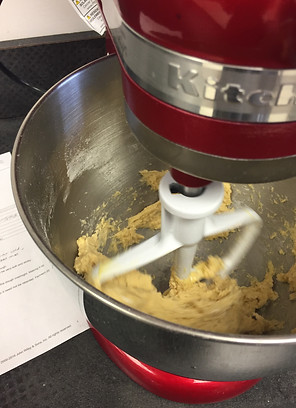
Mixing stage of the brioche

Brioche dough is about to be fermented

I'm a paragraph. Click here to add your own text and edit me. It's easy.

Scaled brioche that is being egg washed

Cooling and sprinkling sugar to decorate and adding another texture to brioche