
WEEK 5
Introduction
Cookery Topic:
Enriched Bread
Quick Breads and Fried Dough
Cookery Method:
This week, we will be finishing the lamination of the croissants. We will be making to two types of dough for quick breads, such as batters and soft dough. The batters will be pour and drop batters, while the soft dough is for biscuits. ( Gisslen 2021 pg. 221)
Gisslen, W. (2021). Professional Baking (8th ed.). Wiley.
Dishes:
Croissants,
Biscuit I and II, Muffins, and Yeast Raised Doughnuts
Prior Knowledge:
I have not made biscuits and doughnuts from scratch. I have made blueberry muffins from scratch once.
Learning Objectives:
This week, we will "prepare muffins, loaf breads or tea breads, coffee cakes, and corn breads. Prepare baking powder biscuits and variations of them. Prepare doughnuts and other deep-fried desserts and pastries. Prepare pancakes, waffles, crêpes, and crêpe desserts." ( Gisslen 2021, pg. 221 & 239) This week, we will be preparing quick breads like muffins and biscuits. We will be preparing yeast raised doughnuts.
Gisslen, W. (2021). Professional Baking (8th ed.). Wiley.
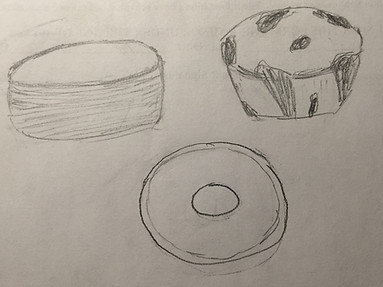
Sketch
Background
Scientific principles:
There only needs to be a little bit of gluten development for quick breads. Chemical leavening agents are used in place of yeast, but they do not provide the same texture as yeast does. "Muffin, loaf bread, and pancake batters are mixed as little as possible, just until the dry ingredients are slightly moistened." (Gisslen 2021 pg. 222) Fat and sugar keeps the gluten development low. Overmixing muffins can cause a tougher texture and irregular holes. The condition is called tunneling.
Gisslen, W. (2021). Professional Baking (8th ed.). Wiley.
Inspiration

Williams, V. (2021, July 26). Erika Council’s tips for better biscuits. King Arthur Baking. Retrieved February 8, 2022, from https://www.kingarthurbaking.com/blog/2021/07/26/erika-councils-tips-for-better-biscuits

Lopez, M. (2022, February 4). Small Batch Blueberry Muffin Recipe. Hummingbird High. Retrieved February 8, 2022, from https://www.hummingbirdhigh.com/2020/05/small-batch-blueberry-muffin-recipe.html

Red Star Yeast. (2021, June 30). Glazed Yeast Doughnuts. Retrieved February 8, 2022, from https://redstaryeast.com/recipes/glazed-yeast-doughnuts/
Origin:
Baking bread using yeast and egg was an extremely long and laborious process. By the middle of the 19th century, the creation of the first baking soda and baking powder quickened the bread making process. Church & Co.'s Soda mailed mini cookbooks with recipes that used their baking soda. ( Arm and Hammer, n.d) It became a household staple in many American kitchens. Church & Co later became to be known as Arm & Hammer. Quick breads are utilized in homes and commercial kitchens, especially large grocery chains.
Methods used:
The muffin method is used for muffins, pancakes, waffles, and loaf type or sheet type quick breads. It is best to not overmix, and it should only be mixed until the dry ingredients are slightly moistened. This method is not used as often anymore. The creaming method is usually for cakes, but it can be used for muffins and loaves. It takes more time, but the texture will be better, and there is less chance of overmixing the batter. It is useful for high fat and sugar content baked goods. The biscuit method is used for biscuits, scones, and similar baked goods, It is also called the pastry method because it can be used to mix pie pastry. Biscuits are made using a variation of the creaming method. There are some biscuits that only use the creaming method. Kneading the dough lets the biscuit rise more, but it should be kneaded very lightly. ( Gisslen ,2021 pg. 222 & 224)
Variations:
The variations in biscuits are buttermilk, cheese, currant, and herb. There can be variation in the mixing method of the biscuit, as it can be the biscuit or creaming method. ( Gisslen, 2021, pg. 226- 227) The muffins can vary in flavors like raisin spice, blueberry, whole wheat, corn, corn cheese, bran, crumb coffee cake, chocolate chip, and zucchini carrot ( Gisslen 228-230). The variations in the yeast raised doughnuts are ring, jelly filled, long johns, fried cinnamon rolls, and twists ( Gisslen , 2021 pg. 242).
Arm and Hammer. (n.d.). A trusted solution for more than 170 years. Pure and simple. Retrieved February 9, 2022, from https://www.armandhammer.com/en-ca/about-us
Gisslen, W. (2021). Professional Baking (8th ed.). Wiley.
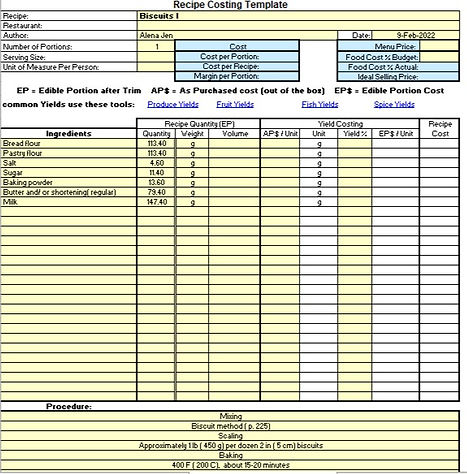
Recipes
_edited.jpg)
_edited.jpg)
_edited.jpg)
_edited.jpg)
Plan of Work

Reflection:
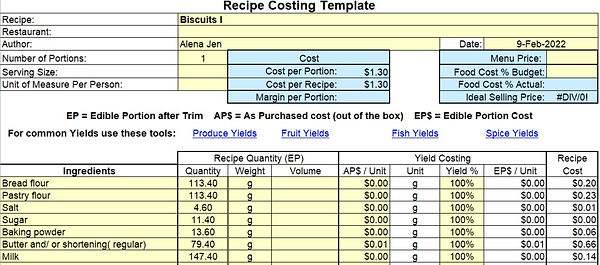
Food Costing
_edited.jpg)
_edited.jpg)
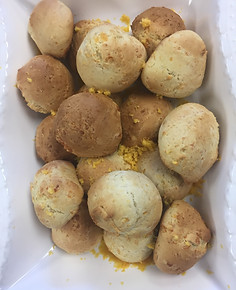
Final Plating

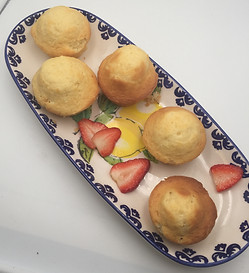
_edited.jpg)
Results
The cooking technique for biscuit II worked. The texture of the biscuit was soft, but some of the smaller biscuits had a tougher texture. The texture was slightly more cake- like. The taste was sweet and slightly salty. The shortening was a dominant flavor in the biscuit. the cheese biscuits did not have much a cheese flavor. The appearance was fluffy and and golden . However, the outside layer was a darker brown for some of the cheese biscuits. The cooking technique for the muffins worked. The texture was fluff and cake like. The taste was sweet, where the flavor of strawberry stood out. The appearance of the plain muffin was golden , and the strawberry muffins had a few strawberries that were visible. The cooking technique for the yeast raised doughnuts somewhat worked. The texture of the doughnuts were extremely sticky, which made it hard to handle. After being fried, the texture of the doughnuts was soft. The taste was sweet as there was a cinnamon sugar coating, and donuts are sweet on their own.
Evaluation
Biscuit II used the creaming method instead of the biscuit method. However, there was a mishap involving the creaming method. During the sifting step, flour and sugar were being sifted rather than creaming the sugar with butter. This changed the overall texture of the biscuit, and we made them into drop biscuits. One possible solution is to cream the sugar and butter first. To get more uniform biscuits, we can weigh and scale all of the biscuits. The texture of the biscuits would be more consistent. The cheese flavor was not very strong in the cheese biscuits, so we can add more cheese next time. For the muffins, the muffin method did work. We did butter and flour the muffins, but they still got stuck to the pan. The muffin tins were older and metal, so they may have not been the best to use. We can try using the silicone baking molds next time. The strawberries had a lot of moisture, so some of the muffin bottoms were stuck on the pan. One solution is to cover the strawberries in more flour as they may not have been enough flour covering the strawberries. There were some strawberry muffins that were overfilled, and they broke in the middle. We made filled them with whipped cream and topped them with berries, making a strawberry shortcake. The yeast doughnuts modified dough method did work. However, the dough was too sticky, and it was extremely hard to handle. I only mixed the batter for 6 minutes, so it may have needed a longer mixing time. Another factor is that all of the ingredients were cold, and room temperature butter and eggs could yield better results. For lamination method for the croissants did work. They constant sessions of folding created many layers of the dough and butter. However, I did not have enough time to allow my dough to rest after the third folding session. I would need to start to folding process a little bit earlier, so that it will have more time to rest.
Conclusions
We did prepare muffins, doughnuts, and baking powder biscuits. The best objective that we did well was the strawberry muffins. It had the fluffiest and best texture out of all the baked items that our group had made. The sifting process prevented flour clumps , and the creativity to make the broken muffins into strawberry shortcakes was a great solution. I learned that creating croissants are a laborious process that takes a lot of time, especially the lamination stage. Time management is crucial not just in the kitchen, but it is also important in school. I still need to practice on managing my time as it did take me a longer time to get all the mise en place for doughnuts. We were able to finish in time, but there was not enough time to do more fillings or different toppings.
Stages of Lab

Egg washing croissants, before baking

Creaming method: Mix butter and sugar first, then the nonfat milk solids and salt
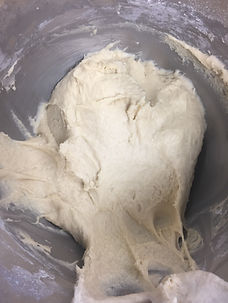
End of the mixing stage. The dough is extremely sticky, may need to be mixed a minute or two more.

Baked for 15- 17 minutes at 400F

Creaming of the first set of ingredients
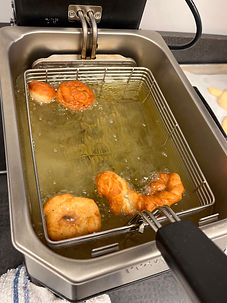
Frying dough at 360 F

Middle still slightly soft, would need to bake a little longer

Add flour, mace, egg, and osmotolerant yeast into dough mixture.. Mix for 6- 8 minutes

Draining excess oil and cooling down doughnuts