
WEEK 10
Introduction
Cookery Topic:
Cheese and Dairy
Cookery Method:
For making the terrine, blanching would be the main cooking method for the vegetables in the terrine. To make the mousse, blending and whipping are utilized.
Dishes:
Coated Chevre Boulettes: Garlic- Herb, Lemon- Pepper, and Paprika
Roquefort Mousse,
Provencal Chevre and Vegetable Terrine,
Basic Tomato Coulis
Prior Knowledge:
I have had no experience in making a terrine. I have made cheese plates at a previous job. The cheese plate would contain in- house crackers, three cheeses: hard, soft, and blue, walnuts covered in honey, fruit jam, and chow chow.
Learning Objectives:
Identify, store and use a variety of milk-based products. Identify, store and serve a variety of fine cheeses. Select fresh milks and creams according to their milk-fat content, and make knowledgeable decisions when substituting one for another. Prepare whipped butter and compound butters. Explain the process of fermentation as it applies to fermented dairy products. Use commercial fermented dairy products in various cold preparations. Produce fermented dairy products in-house. List and explain the five steps in the cheese-making process. Correctly store and handle various types of cheese. Prepare attractive, well balanced cheese platters and cheese boards. Develop a cheese menu for a restaurant or catering operation.
Inspiration

Galer, Chad. “How to Make a Cheese Board.” How to Make a Cheese Board | U.S. Dairy, National Dairy Council, 4 June 2021, https://www.usdairy.com/news-articles/how-to-make-cheese-board.

Fioramore, Mira. “Roasted Vegetable Terrine.” My PCOS Kitchen, 23 May 2021, https://www.mypcoskitchen.com/roasted-vegetable-terrine-pie/.
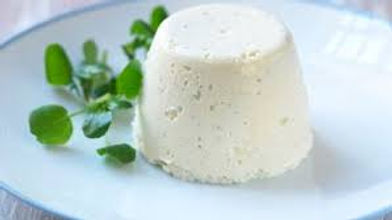
Burnette, Tuck. “Blue Cheese Mousse.” Blue Cheese Mousse Recipe - Food.com, Food.com, 20 Oct. 2016, https://www.food.com/recipe/blue-cheese-mousse-528734.
Background
Scientific principles behind the method of cooking:
“Cheesemaking is adding beneficial bacteria to milk, coagulating the milk into a soft white substance called curd, pressing, and cutting curd into the finished cheese shape. For the final step, the milk must be at the right temperature and right pH at the right time. To make the cheese, milk is pumped into a large tank and warmed to the right temperature. The two different bacteria used in the process are mesophilic and thermophilic bacteria. Mesophilic bacteria grow best in temperatures between 20 and 45 degrees Celsius( 68 and 113 degrees Fahrenheit). They are used to make mellow cheeses such as Cheddar, Gouda, and Colby. Thermophilic bacteria grow best between 45 to 112 degrees Celsius (113- and 252 degrees Fahrenheit) are used to make sharper cheeses such as Gruyere, Parmesan, and Romano” (Gilbert,2018).
Origin:
“The origin of cheese and cheesemaking is unknown. The practice is closely related to the domestication of milk producing animals; primarily sheep, which began 8- 10,000 years ago. Cheesemaking is often referenced in ancient Greek mythology and evidence of cheese and cheesemaking has been found on Egyptian tomb murals dating back over 4000 years. Cheese may have been discovered accidentally by the practice of storing milk in containers made out from the stomachs of the animals. Rennet, an enzyme found in a stomach of ruminant animals, would cause the milk to coagulate, separating the curds and whey. Another possible origin story is stemmed from the practice of salting curdled milk for preservation purposes. Another possible origin story is the addition of fruit juices to milk which would result in curdling the milk using the acid from the fruit juice. By 100 BC, cheesemaking was a widespread phenomenon throughout Europe and the Middle East. During Julius Caesar’s reign, there were hundreds of varieties of cheese being produced and traded throughout the empire. The Roman influence was shown through documentation and trial and error. By 1615 BC, there is an introduction of cheese to Asia. However, there was evidence of cheese called “rushan” that was produced in China during the Ming Dynasty. By the 17th century, cheese was produced in America when English Puritan dairy farmers brought their knowledge of dairy farming and cheesemaking with them from the Old World to the New English colonies.” (National Historic Cheesemaking Center)
Methods used:
“Crème fraiche is made with pasteurized cream and mesophilic culture. The cream is warmed to 72 degrees Fahrenheit. Add the culture and let it rest on the surface of the cream for 2 minutes. Stir in the culture in a top to bottom strokes for 5 minutes. Then, maintain the temperature of the cream at 72 degrees Fahrenheit for 15 to 24 hours. The goal of acidity for the finished cheese is pH 4. The cream will start to show curdling characteristics, which means it is getting close to the goal acidity. The final step is to refrigerate the thickened cream after acidification.” ( Garde Manager)
Variations of the dishes:
There are variations of cheese that span the entire world. Each country and region have a different cheese. There are cheeses that are made from cows, sheep, goats, yaks, and buffalos. Cheese can also be crumbled, shredded, and sliced depending on the dish.
“Cheesy Science.” American Chemical Society, Oct. 2021, https://www.acs.org/content/acs/en/education/resources/highschool/chemmatters/past-issues/2017-2018/december2017/cheesy-science.html.
Culinary Institute of America. Garde Manger: The Art and Craft of the Cold Kitchen, 4th Edition. John Wiley & Sons, 2012.
“History of Cheese.” National Historic Cheesemaking Center Museum and Green County Welcome Center, 19 June 2020, https://nationalhistoriccheesemakingcenter.org/history-of-cheese/.
Plana, Ana. Week 10: Overview, Oct. 2021, https://auburn.instructure.com/courses/1385357/pages/week-10-overview?module_item_id=19964885.
Recipes
_edited.jpg)
_edited.jpg)
_edited.jpg)
_edited.jpg)

_edited.jpg)
Plan of Work

Reflection
Final Plating
Results
The coated chevre boulettes texture was soft with the varied flavor profile depending on the topping. The lemon- pepper taste was light that complimented the chevre. The garlic herb and lemon peppers gave a savory and spicy flavor. The colors of yellow, green, and red made them appetizing. The Roquefort mousse had a strong smell and distinct aftertaste. It paired well with bread and crackers. The tomato coulis was light and added a nice color when pairing with the cheese. The texture of the coulis was a little thinner than jam. The texture of the terrine was softer than anticipated. The artichokes was a dominant flavor throughout the terrine. The chard and red peppers added more color to the dish. All the layers tasted good together, but the texture was slippery and did not stay together.
Evaluation
The terrine did not stay together. The chard was not dry enough which could have added more liquid. The roasted peppers were in a jar with liquid, which could have added more liquid. The terrine was not weighed down, so there was no compression of the layers. We did not refrigerate for 6 hours, which would have helped the terrine solidify more and stay together. To improve the terrine, fully drying off the chard would help. Roasting the red peppers in the oven could take out more moisture. Weight and more time would help.
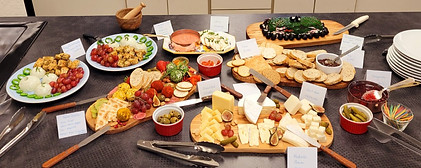
Stages of the Lab

Conclusion
We incorporated the cheese into the terrine. We layered it together successfully. Time management is a skill that I will continue to work on inside and outside of the kitchen. We plated after the set time, and the time slipped away. In a work environment, set times are extremely important, especially when there is a customer. Being open to other alternatives when a ingredient is not there, as we did not have green beans for the lab. Adaptability would be a characteristic that can lead to solutions in any environment.
