
WEEK 11
Introduction
Cookery Topic:
Garde Manger- Terrine, Pate, Roulades, and Galantines
Cookery Method:
Baking, roasting, and sautéing are the cooking methods that are utilized for the terrines and the galantine. Depending on the terrine or galantine, the cooking methods will be varied.
Dishes:
Mediterranean Seafood Terrine,
Roasted Vegetable & Goat Cheese Terrine,
And Roasted Asian Duck Galantine
Inspiration

Smarter, E. (2016, September 22). Seafood Terrine. Eat Smarter USA. Retrieved October 27, 2021, from https://eatsmarter.com/recipes/seafood-terrine.
Prior Knowledge:
I first became familiar with making a terrine from last week’s cheese and dairy lab of the Provencal Chevre and Vegetable Terrine. The terrine needs more time to completely set before serving. The multiple colors and textures are crucial for the taste and presentation of the terrine. In an earlier lab, we had a mushroom pate that I enjoyed the umami flavor and smooth texture. In our food production lab, the entrée team made a pork roulade. I Practiced rolling the pork roulade as tight as possible with the filling. I am unfamiliar with making a galantine and cooking with a duck. However, galantines and roulades are similar in that that need to be rolled with stuffing.
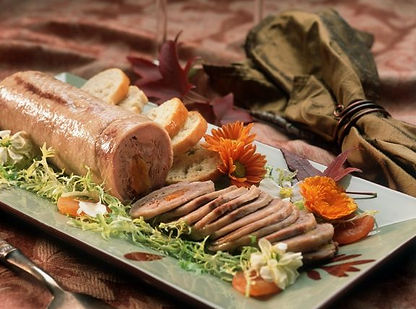
Smarter, E. (2016, October 7). Duck Galantine. Eat Smarter USA. Retrieved October 27, 2021, from https://eatsmarter.com/recipes/duck-galantine.
Learning Objectives:
“Explain the use and preparation of forcemeats. Identify various types of forcemeats including straight, country-style, gratin, and mousseline. Describe the procedure for making terrines. Understand how to prepare pâté en croûte.
Explain the process of making galantines and roulades. Recognize proper method of working with foie gras including grading, cleaning, and marinating. Provide examples of nontraditional “terrines” made without forcemeats.” ( Plana, 2021)
Plana, A. (2021, October). Week 11: Overview. Retrieved October 27, 2021, from https://auburn.instructure.com/courses/1385357/pages/week-11-overview?module_item_id=19965304.
Background
Scientific principles behind the method of cooking:
“Chilled ingredients and equipment is important when preparing the forcemeat. Keeping the forcemeat below 40 F/ 4 C keeps the food out of the danger zone, reducing the risk of food borne illness. Temperature control is also key to achieving the best results. When forcemeats are kept well chilled throughout processing, mixing, and cooking, they require less fat, yet still have a smooth texture and an appealing mouthfeel. The flavor of the forcemeat itself is generally better as well.” (CIA 303)
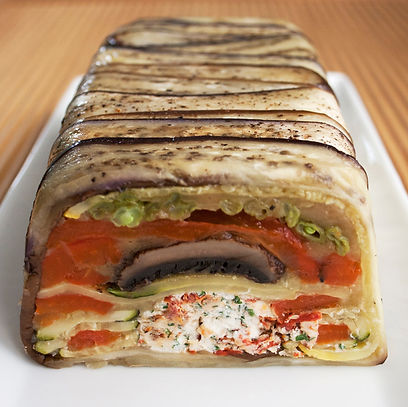
Vegetable terrine with goat cheese inlay and the final challenge - notes from home plates. MasterCook. (2015, December 23). Retrieved October 27, 2021, from https://www.mastercook.com/app/recipe/WebRecipeDetails?recipeId=6408173.
Origin:
“Pates and terrines are basically large sausages that are in a mold, either earthenware or porcelain ( en terrine), in dough ( en croute) or in skin ( galantines and ballotines). Without a mold, they’re meatloaf. Technically speaking, terrine is short for pate en terrine. Pates made from meat and fish have been around for centuries. They remained popular from the Middle Ages up through the 1900s, and today they continue to be part of restaurant cooking, but they do not have much of a presence in home cooking. Pates are often associated with French cooking, especially when French haute cuisine elevated pates. In America, pates were misinterpreted by cooks that did not fully understand the complexity of the multiple characteristics. Americans’ general impression of pates was that it was a meat spread or liver spread, and it must include foie gras. However, pates can be made from chicken and salmon.” (Ruhlman and Polcyn 202)
Methods used:
“The structure of forcemeat is important when preparing for terrines, pates, roulades, galantines, sausages, as well to prepare stuffing for other items. Forcemeat are made from raw products with the exception of the gratin forcemeat. Selection of the meats should be well exercised cuts as they have a richer flavor. However, meats for garnish can be delicate such as the tenderloins or poultry breasts. Recipes containing shrimp or scallop mousseline would use pike as a binder. The salt and seasonings are vital to produce good forcemeat. The salt draws out the proteins of the meat, which are the source of the forcemeat’s bind, and it contributes to the unique flavor. The seasoning and marinating meat will intensify the flavor. A second binder is usually needed for country style and gratin forcemeats. The most common secondary binders are eggs, non-fat dairy milk powder, and panadas. Panadas are from starchy items such as pureed rice or potatoes, bread soaked in milk, and other starch heavy items. Garnish items add color, flavor, and texture.” ( CIA 301-303)
Variations of the dishes:
“There are many variations of pates depending on the meat source and the style of the forcemeat. There are four styles of forcemeat: straight, country-style, gratin, and mousseline. Some terrines are by themselves while others may be aspic bound terrines. Aspic would change the overall texture of the terrine. Depending on what is being made, it could be poached or baked. This will also change the overall texture and flavor of the dish. “(CIA 305-313)
Culinary Institute of America. (2012). Terrines, Pates, Galantines, and Roulades. In Garde Manger: The art and craft of the Cold Kitchen, 4th edition (pp. 301–315). essay, John Wiley & Sons.
Ruhlman, M., Polcyn, B., & Solovyev, Y. (2013). The Cinderella Meatloaf. In Charcuterie: The craft of salting, smoking, and curing (p. 202). essay, W.W. Norton & Company
Recipes


Plan of Work

Reflection
Results:
The texture of the Seafood Terrine was soft, and shrimp flavor would be the prominent flavor. The color was gray with the blue and pinkish/ reddish gelatin added more color to the overall dish. The lettuce sail added another color. The texture of the Roasted Asian Duck Galantine had a soft texture on the inside, while the skin was slightly rubbery, especially when wrapping the filling with chicken skin. The inside of the galantine was slightly pink, and it reached the correct internal temperature. The outside of the galantine was light. The texture of the vegetable and goat cheese terrine had multiple textures and colors. The texture is soft from the cheese, while it is slightly crunchy texture of the vegetables. The goat cheese pairs nicely with the roasted vegetables.
Evaluation:
There was a prominent smell of chlorine from the seafood terrine. The origin of the smell may have been from the shrimp and where the shrimp were fished at. One way to mitigate this is to find other shrimp from another area. The seafood terrine did stay together, and it was chilled at a long time. The vegetable and goat cheese terrine stayed together, but it began to fall apart once cut. One reason that it did not stay together was that it was chilling at a shorter time than the recommended time. If the terrine stayed in cooler for longer, then the terrine would be more successful. The Roasted Asian Duck Galantine did not really work. We were running low on time, so the filling was not marinaded at all. For the next time, it would be best to break down the duck and make the marinade at a quicker pace. We ground up the duck breast on accident, instead of having it as a separate layer. The skin was kind of rubbery, so one way to help would be baking it into s water bath with the oven at a lower temperature.
Conclusion:
I learned more about the various types of forcemeat and the application in the real world. The filling of the duck was good, but their rest of it did not taste good together. Time management is a skill that would be beneficial in every environment. If a weight is needed for a dish, I will sure to press out as much moisture as possible. Being more imaginative in creating solutions and time management would be two skills that I will need more practice in. Taking more risks in the kitchen and time management. Rolling the filling into the skin took the longest time, while rolling it in the tin would be easier.
Final Plating


Stages of the Lab


