
WEEK 3
Introduction
Cookery Topics:
Charcuterie and Sausage
Curing
Cookery Method:
To learn how different sausages are made with varying techniques and processes.
How differing curing mixes affects the gravlax's overall taste and texture.
Inspiration

Dishes:
Irish Breakfast Sausage, Carne Fria, and Gravlax
Prior Knowledge:
I have not had any experience with making sausages. I have not made a charcuterie board before.
Learning Objectives:
Understand the role of sausages in culinary history. Identify necessary ingredients for sausages. Explain the importance of proper equipment. selection, care and use in making sausages. Classify various types of sausage. Discuss fermented sausages and their manufacture. Describe the process of making basic grind sausages. Contrast the basic process with the procedure for. emulsion sausages. Recognize the value of testing. Distinguish suitable garnishes for sausages. Clarify the various types of sausage shaping options. and preparation methods for each type. (Plana, 2021)
Plana, A. (2021, August). Week 3: Overview. https://auburn.instructure.com/courses/1385357/pages/week-3-overview?module_item_id=19964456.
Background
Scientific principles behind the method of cooking:
Abraham, Lena.(2020, September 16). This baked Sausage & peppers is a WEEKNIGHT HERO. Sausage & Peppers. https://www.delish.com/cooking/recipe-ideas/a22628682/best-sausage-and-peppers-recipe/.

Lemm, E. (2021, February 4). Tuck in to a traditional irish breakfasts. A Classic Irish Breakfast Recipe. https://www.thespruceeats.com/a-classic-irish-breakfast-5072861.

After the sausages have been refrigerated for a few days, they will need to be cooked. One of the cooking methods is sautéing, and it is cooking at a high temperature with a little bit of fat or oil. Sautéing requires more movement, so the food is cooked evenly. When heat is applied correctly “it toasts and roasts and caramelizes sugars into dark and nutty deliciousness.” (Severson, 2014)
Baruch, Lindsey. (2020, November 30). Salmon Gravlax (Cured Salmon!). https://lindseyeatsla.com/salmon-gravlax-cured-salmon/.
Origin and history:
The word sausage is derived from the Latin salsus (“salted”), which “refers to a food processing method that has been around for centuries. It goes back to ancient Babylonia, Greece, Rome, and early North American Indians made pemmican, a compressed dried meat and berry cake.” (Britannica, 2021). This was a pre- refrigeration solution, so the combination of ground meat, fat source, and salt helped preserve proteins.
Method of cooking:
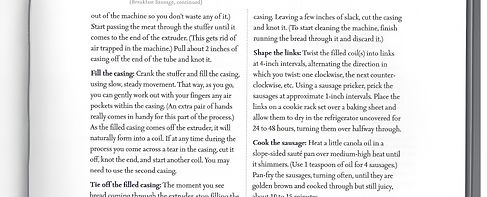
The procedure for making sausage is selecting ingredients, grinding and mixing, stuffing, and thermal processing. Depending on the type of sausage, it will affect the temperature and cooking times. The casing and spices will vary depending on the desired sausage. ( Marchello & Garden- Robinson, 2017)
Variations of dish:
Depending on region and country, it will affect the sausage type. In the United States, there are over 250 types of the sausage in the country. Every country has their own variation too.
Marchello, M., & Garden- Robinson, J. (2017, November). The Art and Practice of Sausage Making - Publications. https://www.ag.ndsu.edu/publications/food-nutrition/the-art-and-practice-of-sausage-making.
Severson, K. (2014, September 22). Staying cool when the fat hits the fire. The New York Times. https://www.nytimes.com/2014/09/24/dining/the-fundamentals-of-pan-frying-sauteing-and-searing.html.
The Editors of The Encyclopedia Britannica. (2021, August 16). sausage. Encyclopedia Britannica. https://www.britannica.com/topic/sausage
Recipes


Plan of Work

Reflection
Results:
The gravlax without the coriander had a more tender texture than the gravlax with the coriander. Both gravlax had salty flavor profiles, with the gravlax with the coriander being a little bit more salty. Both gravlax had a bright pink appearance. The carne fria had a soft texture, with a salty and umami taste.
Evaluation:
After the lab, the sausage making process took longer than expected on every step. It took longer because it was the first time that I and others have experienced it. We used a half portion of the ground sage, since dry ingredients tend to be more potent. One of the areas of challenge was tying off the ends with gloves on, it was easier to do it by hand. The carne fria with the cracker had a nice balance of flavor. The gravlax with the coriander was tougher and , and one possibility is that not all the salt was not washed off. I preferred the gravlax with the simpler cure mix. The combination of cream cheese with lemon and capers complimented the saltiness of the gravlax.
Conclusion:
My main learning objective was seeing the end result of the curing process with the gravlax and learning the sausage making process. The bagel, gravlax, sour cream , and Dijon mustard tasted similar to lox and cream cheese bagel. I learned how to cut the salmon, and a key takeaway is to cut as close to the skin. I will need more practice to cut thinner and more consistent pieces of salmon. It was easier to make roses out of the thinner pieces than the thicker pieces. From detangling the hog casings, grinding and mixing the meat, stuffing and filling the casing, and linking the sausage were each step required a lot of patience and time.
Stages of Lab

Gravlax Recipe from Culinary Institute of America's Garde Manger, The Art and Craft of the Cold Kitchen

Gravlax Recipe from Serious Eats
Final Plating

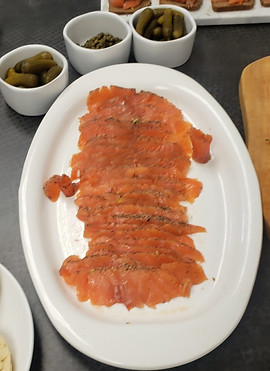


Cream cream mixture with capers and lemon zest for the gravlax

Cutting the meat off the pork (Boston Butt)
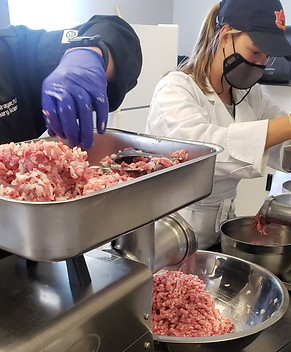
Grinding and mixing process


Hog casings before putting it on the sausage stuffer
Hog casings on the sausage stuffer
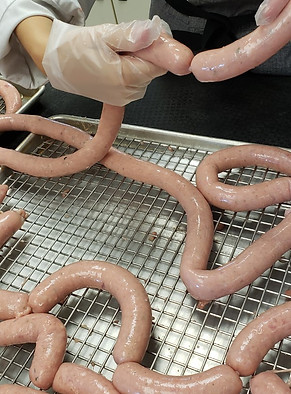
The twisting movement to make the links

The casings are stuffed and linked